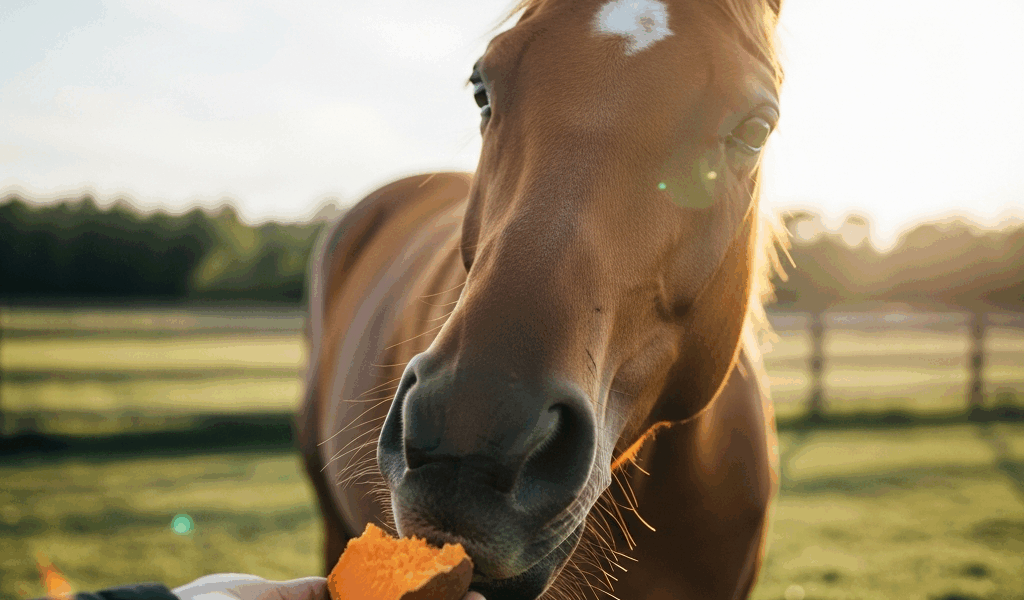
Can Horses Eat Sweet Potatoes? Safe — But Not Regular Potatoes
Sweet potatoes have gotten complicated with all the conflicting information flying around online. Last fall I stood in my kitchen holding a sweet potato in one hand and my phone in the other, frantically searching, while Delia watched me through the window like I was personally offending her by taking so long. The short answer: sweet potatoes are safe for horses. The longer answer involves a distinction that could genuinely save a horse’s life if you don’t already know it. Regular potatoes are not safe. Not even a little. And the two get confused constantly — which is the whole problem.
Sweet Potatoes Are Safe — Regular Potatoes Are Not
Probably should have opened with this section, honestly. Maybe just made it the headline in giant red letters and called it a day.
Regular potatoes — the Russets sitting in your pantry, the Yukon Golds, the red-skinned ones you roast on a Sunday — belong to the nightshade family, Solanaceae. They contain solanine, a glycoalkaloid that horses cannot safely process. We’re talking gastrointestinal distress, neurological symptoms, and in large enough quantities, death. This isn’t a “feed sparingly” situation. Regular potatoes should never reach a horse, cooked or raw, in any amount.
But what is a sweet potato, exactly? In essence, it’s a root vegetable from the family Convolvulaceae — the morning glory family. But it’s much more than that distinction suggests. No solanine. No nightshade connection whatsoever. The name is where the similarity to a regular potato ends. Botanically, a sweet potato and a Russet are about as related as a carrot and a tomato — same grocery store aisle, completely different biology.
Don’t make my mistake. I once assumed that because both were called “potatoes,” the rules were roughly the same. They are not. If you’ve ever tossed a piece of leftover baked potato to a horse thinking it was harmless, please stop. The risk is real and it’s not worth it.
One more thing worth flagging — potato plant leaves and green-tinged potato skins carry even higher solanine concentrations than the flesh itself. If your horses have access to a garden where potatoes grow, that’s a situation worth fixing before it becomes a problem.
How Much Sweet Potato Can a Horse Have?
So you’ve got a sweet potato and a horse who is extremely interested in it. Here’s what the numbers actually look like.
A reasonable serving is about half a medium sweet potato — roughly 65 grams, somewhere around 2.5 ounces. That portion runs approximately 5 grams of sugar and 10 grams of starch. A standard medium carrot, for comparison, weighs about 60 grams and has around 3 grams of sugar. So a half sweet potato is a bit richer than a single carrot — not dramatically so for a healthy horse, but richer.
Most horse owners and equine nutritionists land on one serving per day as the ceiling — and not every single day, either. Treats are treats. A sweet potato is nutritionally denser than a carrot or an apple slice, so treating it like a daily staple misses the point. Think of it the way you’d think about giving your horse something more indulgent on occasion, not as a feed supplement you’re building a routine around.
Cut sweet potato into chunks no larger than one inch before feeding. Horses don’t always chew as carefully as we’d like — choking is a genuine risk with any firm, chunky treat. Smaller pieces are just safer. This applies whether you’re going raw or cooked.
I keep a kitchen scale — nothing fancy, a $12 Etekcity model — near my feed area now. Got lazy about eyeballing portions one afternoon and ended up giving Delia considerably more than I intended. She was fine, but it was a good reminder that “half a sweet potato” looks very different depending on which sweet potato you grabbed off the counter.
Nutritional Benefits of Sweet Potatoes for Horses
Sweet potatoes have a reputation as a nutritious food — and that holds up when you look at what horses actually need.
The biggest story here is beta-carotene. Sweet potatoes are exceptionally high in it — a 100-gram serving blows past the human daily recommended intake, and horses convert beta-carotene to vitamin A in much the same way we do. That matters for vision, immune function, and reproductive health. Horses on good pasture usually get plenty, but stabled horses on hay-heavy diets can come up short — and that’s where an occasional sweet potato actually does something useful.
- Beta-carotene — converts to vitamin A, supports immunity and eye health
- Vitamin C — horses produce their own, but additional dietary vitamin C from whole food sources doesn’t hurt
- Potassium — important for muscle function and hydration balance, especially in working horses
- Fiber — modest but present, contributes to digestive health
- Manganese — supports bone development and enzyme function
How does this stack up against carrots — probably the most common horse treat going? Carrots are lower in calories and starch, higher in water content, and similarly rich in beta-carotene. For a healthy horse, either works fine as an occasional treat. Sweet potatoes are a bit more calorie-dense and starchier, so carrots win on simplicity for most horses. Sweet potatoes offer variety and a slightly different micronutrient profile. That’s what makes them endearing to us as horse owners — a little nutritional upside alongside the novelty.
None of this replaces quality hay, balanced feed, and fresh water. A treat is a treat. Sweet potatoes aren’t a supplement — they’re a snack that happens to have some nutritional value attached.
Which Horses Should Avoid Sweet Potatoes
This section matters more than most. I’d rather be direct here than vague.
If your horse has any of the following conditions, skip the sweet potato entirely:
- Equine Metabolic Syndrome (EMS) — horses with EMS have impaired insulin regulation, and the sugar and starch in sweet potato can spike insulin in ways that cause real problems
- Cushing’s Disease (PPID) — Cushing’s horses are already at elevated laminitis risk; extra dietary sugar and starch adds to that load unnecessarily
- Insulin resistance — same concern as EMS; even a modest starch hit from a treat can be problematic for horses already managing this
- Horses on a weight management plan — sweet potatoes are calorie-dense for a treat; if the diet is already being trimmed down, this isn’t the snack to introduce
- History of laminitis — dietary sugar and starch management is central to laminitis prevention, and sweet potatoes introduce unnecessary risk into that equation
This isn’t about sweet potatoes being a dangerous food — they’re not. For most horses, a small portion is completely fine. The issue is that metabolic horses have a fundamentally different relationship with carbohydrates than a healthy horse does. What’s a harmless occasional treat for Delia could apparently trigger a painful episode in a horse already managing insulin dysregulation. Different animal, different rules.
If you’re genuinely unsure which category your horse falls into, ask your vet. That’s not a hedge — it’s just the right move when you’re managing any horse with metabolic history.
Raw vs Cooked — Does It Matter?
Both are safe. Short answer done.
Raw sweet potato is crunchy — most horses enjoy that. Wash it, cut it into small cubes, done. No cooking required. The texture lands somewhere between a firm apple and a raw carrot, so horses that enjoy those treats usually take to raw sweet potato without much convincing.
Cooked sweet potato — baked, boiled, steamed — is softer and may be slightly easier to chew and digest. Older horses or horses with dental issues might do better with the cooked version cut into small pieces. That’s a reasonable accommodation to make.
What you absolutely cannot do is feed sweet potato that’s been prepared for human consumption. Butter, salt, brown sugar, marshmallows, cinnamon, any seasoning at all — none of it belongs anywhere near a horse’s feed. Plain sweet potato only. If you baked one for dinner and have half left over, check what’s on it before you share. A plain baked sweet potato with nothing added is fine. The loaded Thanksgiving version is not.
Surprised by how often this needs to be said, but no seasonings means no seasonings. Horses don’t need their food to taste like a holiday side dish — they just want the sweet potato.
One other note — the skin is fine. You don’t need to peel it. Horses generally aren’t bothered by it, and it’s safe. Just wash the sweet potato thoroughly before cutting, the same way you would with any produce you’re handling. Basic stuff, but worth saying.
Bottom line: sweet potatoes are a legitimate, safe treat for healthy horses when given in reasonable portions. Keep the serving to about half a medium sweet potato, cut it small, skip it entirely if your horse has any metabolic concerns, and never — ever — confuse it with a regular potato. That last point alone is worth keeping front of mind every single time you open the produce drawer.


Leave a Reply