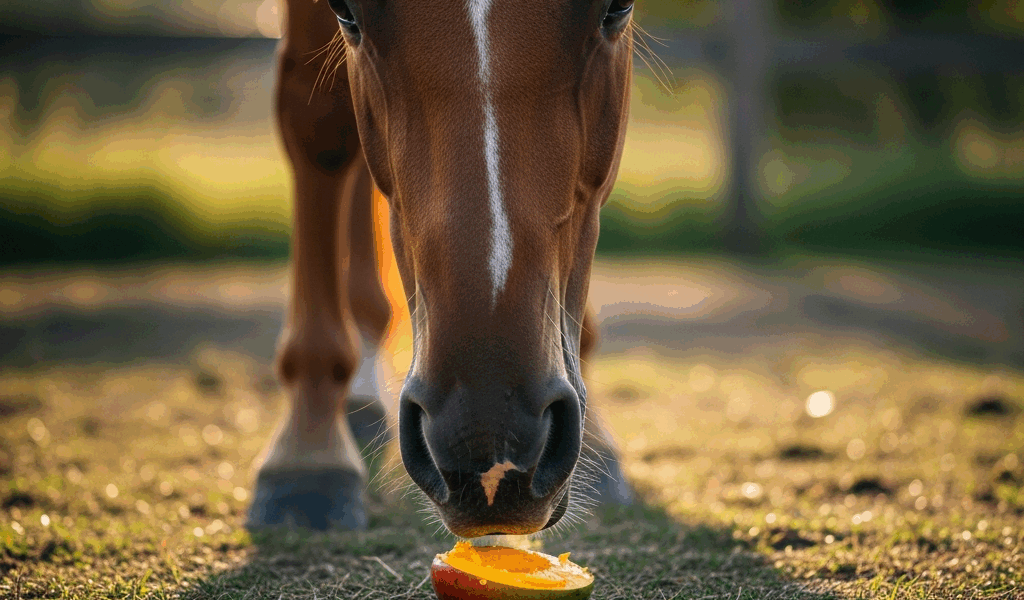
Can Horses Eat Mango? Yes — But There Is a Stomach Ulcer Risk
Can Horses Eat Mango? Yes — With an Important Caveat
Feeding horses has gotten complicated with all the conflicting advice flying around. Mango is a perfect example of the latter.
But what is the real story with mango and horses? In essence, it’s a fruit that won’t immediately poison your horse. But it’s much more than that. There’s published research — not speculation, actual documented findings — connecting mango consumption to gastric ulcers in the squamous region of the horse’s stomach. Real lesions. Real horses. That’s not something you’ll find mentioned on most horse-feeding websites, and honestly, it should be.
Horses tend to love the stuff, too. That sweet, floral smell gets their attention fast. Which makes it trickier — because the things horses go crazy for aren’t always the things that serve them well.
If you’ve got a horse with ulcer history, or one that’s deep in a competition schedule, or just one that’s been a little stress-prone lately — mango is probably not your best treat option. Even for healthy horses, “small amounts occasionally” has to mean something concrete, not just a casual handful cut up on the kitchen counter.
Here’s what the research actually shows, how to feed mango if you decide to go ahead anyway, which horses need to avoid it entirely, and what the safer alternatives look like.
The Gastric Ulcer Risk — What Research Found
Probably should have opened with this section, honestly — because this is the part that almost every “can horses eat mango” article skips without a second thought.
Researchers at Kentucky Equine Research looked into what mango actually does to a horse’s gastric health. Their findings were specific: mangoes carry a high soluble carbohydrate load, and those carbohydrates appear to shift the gastric environment in ways that promote ulceration in the squamous mucosa — the upper, non-glandular portion of the stomach.
That distinction matters. The squamous region doesn’t produce protective mucus the way the glandular region does. It’s more exposed, more vulnerable. Equine Squamous Gastric Disease — ESGD — is already the most common form of ulcer syndrome in horses, and it’s the form most directly shaped by diet and feeding habits. Anything that drops stomach pH or extends acid contact time in that region raises the risk profile considerably.
What the KER work described was gastric relaxation triggered by mango’s soluble carbohydrate content — which actually speeds up how quickly stomach contents move through. Counterintuitive as a risk factor, but faster gastric transit means less forage buffering, more direct acid contact with the squamous lining, and a measurable pH drop. The lesions that developed during mango season resolved after horses stopped eating it — which is encouraging, but “it gets better when you stop” isn’t the same as safe. Squamous ulcers hurt. They affect behavior, willingness, and performance in ways that can take weeks to even identify.
Don’t make my mistake. A gelding I was managing through a rough rehab period — we’d been supplementing with fruit treats to keep his spirits up, mango chunks from the grocery store, nothing we thought twice about — started showing girthing sensitivity around week three. Scoped him, found early squamous lesions. The vet asked what we’d been feeding him. We made the connection fast. Pulled the mango, started him on GastroGard (omeprazole paste, somewhere around $38–$45 per tube at the time), and he resolved over about six weeks. Expensive lesson. Entirely avoidable one.
How to Feed Mango Safely If You Choose To
If your horse is healthy, has no ulcer history, gets consistent forage access, and you still want to offer mango now and then — here’s how to actually do it carefully.
Remove the Pit — Non-Negotiable
The mango pit is a choking hazard, full stop. It’s large, irregularly shaped, fibrous in a way that can lodge in the esophagus — and horses can’t vomit. An esophageal choke is a genuine emergency. Depending on how long it goes and what intervention becomes necessary, you’re looking at $500 to $2,000 or more. Beyond the mechanical problem, mango pits contain amygdalin, a cyanogenic compound that breaks down into hydrogen cyanide. A single pit probably won’t acutely poison a 1,200-pound horse — but there’s no reason to find out. Remove it. Every time.
Remove the Skin
Mango skin contains urushiol — the same compound that makes poison ivy miserable. Horses can react to it both dermatalogically and gastrointestinally. This detail gets skipped constantly on horse feeding sites, probably because people just don’t think about it. Skin-on mango is a meaningfully different risk than peeled flesh. Peel it completely before feeding.
Cut It Small — Specific Pieces, Not a Handful
Aim for pieces roughly one inch cubed or smaller. Two to four pieces as an occasional treat — once a week at most, not daily. A full mango contains around 45 to 50 grams of sugar. Not enormous in absolute terms, but horses aren’t built to handle large sugar hits outside the context of forage. Stack that up daily and you’re compounding risk for no real benefit.
Fed this way, by a healthy horse with solid forage access, mango is unlikely to cause a dramatic problem. That said, “unlikely to cause a dramatic problem” sets a lower bar than “safe” — and that distinction is worth keeping in mind.
Which Horses Should Never Eat Mango
This section matters more than the feeding instructions above. That’s what makes the ulcer research so important to horse owners — it moves mango from the casual treat category into something that requires actual thought about the individual animal.
- Horses with active gastric ulcers. If your horse is currently being treated for ESGD or Equine Glandular Gastric Disease, mango is off the table entirely. The goal is reducing acid exposure and supporting mucosal healing — adding soluble carbohydrates that affect gastric motility and pH works directly against that.
- Horses with a history of ulcers. Even horses scoped clear and fully treated carry higher susceptibility than horses that have never had them. The tissue stays more vulnerable. Don’t reintroduce known risk factors without a real reason to.
- Horses on low or inconsistent forage. Forage is the primary acid buffer in a horse’s stomach. A horse that goes long stretches without it — hay-limited diets, long stall hours, inconsistent feeding schedules — already has elevated baseline risk. Mango on top of that is piling on.
- Stress-prone and competition horses. Travel, showing, stalling changes, and training intensity all drive ulcer prevalence up. Some studies put the number above 60% in performance horses. If your horse lives in that world, treat selection actually matters.
- Horses with Equine Metabolic Syndrome or insulin dysregulation. The sugar load in mango — fructose, glucose, sucrose — puts it in the same category as high-sugar hay or a handful of grain for horses managing blood glucose issues. The metabolic concern actually takes priority over the gastric one here.
- Easy keepers prone to laminitis. Same reasoning. The sugar content alone is disqualifying. Full stop.
If your horse lands in any of these categories and you want to give them something special, there are genuinely better options.
Safer Tropical Fruit Alternatives
Tropical fruits are popular treat choices — colorful, aromatic, and horses tend to be enthusiastic about them in a way that’s honestly pretty entertaining to watch. Mango isn’t the only option in that category, and the alternatives have cleaner safety profiles.
Watermelon might be the best option, as horse treat selection requires balancing sugar load against digestive compatibility. That is because watermelon is high in water content and lower in the specific soluble carbohydrates linked to the gastric issues described above — and most horses are absolutely wild about it. We’ve covered watermelon in detail elsewhere on this site, including rind safety and serving sizes. Read the full watermelon guide here.
Banana is another solid choice. Soft, easy to chew, well-tolerated, and the potassium content is a mild bonus for horses in heavy work losing electrolytes through sweat. First, you should consider how often you’re reaching for high-sugar treats overall — at least if you’re managing a horse that’s in heavy training or already showing digestive sensitivity. See the banana guide here.
While you won’t need to avoid all fruit permanently, you will need a handful of guidelines that actually reflect what the research shows — not just vague reassurances about moderation. Mango isn’t poisonous. It’s not a neutral treat either. For a healthy horse with good forage access, a few small cubes once in a while is probably fine. For any horse in a vulnerable category — and there are more of those than most owners initially realize — there are better choices that won’t land you in an ulcer workup you could have avoided entirely.
Know your horse. Know the research. Choose accordingly.




Leave a Reply