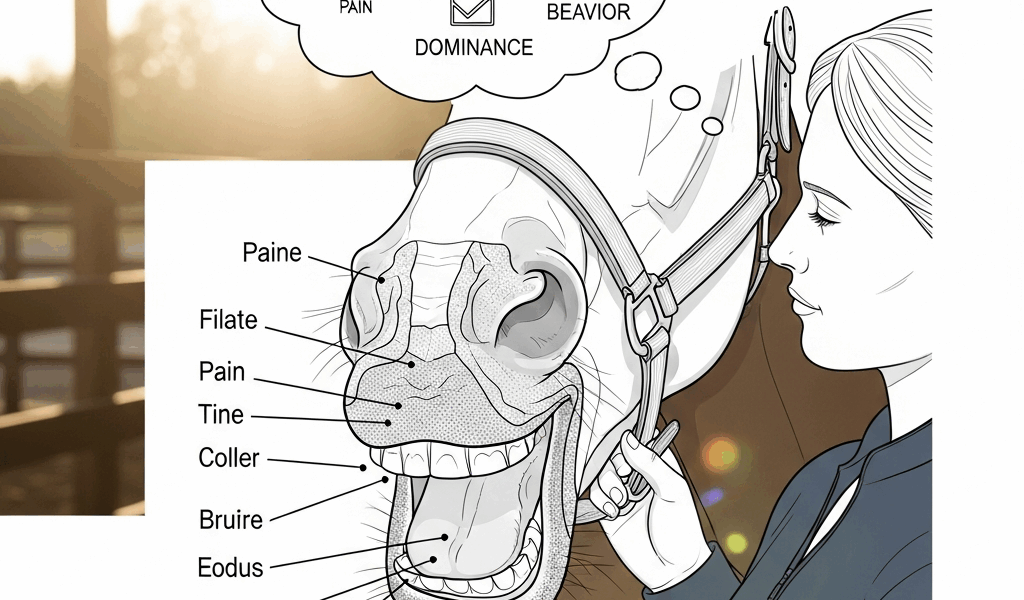
First, Figure Out Why Your Horse Is Actually Biting
Horse biting has gotten complicated with all the conflicting advice flying around. Punishment, treats, firm corrections, ignoring it — everyone has an opinion. But here’s the thing most people skip entirely: punishing the wrong problem makes everything worse. A horse biting because of ulcers isn’t being disrespectful. A horse biting because it learned that nipping makes you step back is playing a completely different game than the one you think you’re playing.
Before you correct anything, figure out which bucket your horse actually falls into:
- Pain-related biting: Shows up in specific spots — girth area, back, mouth. Usually paired with other tells. Ears pinned during tacking. Reluctance to move forward. Flinching when you touch the sore spot. This bite isn’t aggression. It’s a warning you’re missing.
- Dominance or boundary testing: Nipping at feeding time, going after strangers, getting mouthy during grooming. Your horse is checking whether you’ll actually hold your ground. These horses are confident. Sometimes pushy. That’s what makes this type endearing to us horse people — they’ve got personality — but it still needs addressing.
- Learned behavior: The horse bit once, you flinched, and now biting is the most efficient tool in the box. Maybe someone accidentally rewarded it with treats years ago. Doesn’t matter how it started. Now it’s just habit.
Spent fifteen minutes last week watching a client’s mare bite her hand every single time she went to bridle her. Same spot, every session, like clockwork. Turns out wolf teeth had erupted and were cutting into her gums. My client was three days away from starting a correction program. One extraction later — $150 at their regular equine dentist — and the biting stopped cold. Don’t make my mistake of assuming behavior before you’ve checked the body.
When Biting Is a Pain Signal, Not a Behavior Problem
Pain-related biting is the most dangerous situation to misread. Correcting it makes everything worse. Your horse isn’t being difficult or disrespectful. Something hurts, and biting is the only language it has left after subtler signals got ignored.
Girth-area and flank biting
Probably should have opened with this section, honestly — it’s the most common complaint I hear. Girth-area biting almost always means something physical is wrong. Check three things before you try anything else:
- Girth fit and tightness. Pull the saddle off and look at the girth groove. Red marks? Indentations in the skin? A girth that’s too narrow digs into muscle like a wire. Some horses need a 4-inch girth; others genuinely need 5 or 6 inches — I’m apparently a 5-inch person myself, and switching from a cheap 3-inch synthetic changed everything for my gelding. Tightening harder won’t stop the biting. It will make it worse. If there are marks on the skin after 30 minutes of riding, the girth is your problem.
- Saddle fit. Get a saddle fitter out. Runs $200–$400 depending on where you are. Worth every dollar if your horse is biting during tacking. A saddle that bridges — meaning it doesn’t contact the back evenly — or sits too far forward causes the horse to bite at the girth area as a straight-up protective reflex. It’s not behavioral. It’s physics.
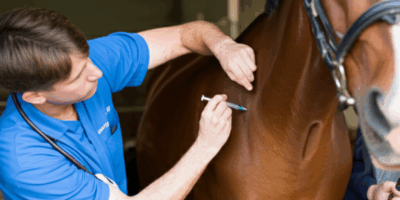
- Back and flank soreness. Run both hands along either side of the spine, slowly. Flinching? Dropping a shoulder? Turning to bite when you press certain spots? Call your vet. Could be kissing spines, muscle strain, ulcers — any of them. A chiropractic evaluation runs $150–$300 and can pinpoint exactly where the sensitivity lives.
Biting during grooming over the back or flanks
Your horse stands perfectly still until you reach the back third of his body. Then the teeth come out. That’s a pain response — not attitude, not stubbornness. The skin might be hypersensitive from ulcers. Could be deeper muscle soreness. Could be both.
Stop grooming that area until you know what’s wrong. Call the vet if the sensitivity is new or getting worse over time. In the meantime, swap to a softer tool — a rubber Grooma curry instead of a metal one — and work around the sensitive zone entirely. Don’t punish the biting here. You’d be punishing a horse for saying “ouch.”
Biting when bridling or during bit work
But what is a wolf tooth, exactly? In essence, it’s a small vestigial premolar that erupts somewhere around age 5, usually right where the bit sits. But it’s much more than a minor inconvenience — those edges are sharp and they bleed. An equine dentist pulls them in under ten minutes. Cost runs $100–$200. If the biting happens specifically when the bit goes in, wolf teeth are the first thing to check. After that, look at uneven tooth wear. A dental float — professional teeth rasping — runs $150–$300 and should be happening annually regardless.
Also look at the bit itself. Too wide and it pinches the corners. Too narrow and it presses into the bars. A half-inch difference in bit width genuinely matters. TMJ problems are real too — some horses have a jaw imbalance that makes chewing painful — and a vet or equine chiropractor can assess it in one appointment.
Rule out the physical causes, make the adjustments, and the bridling biting usually just stops on its own.
How to Correct a Horse That Bites Out of Habit
Learned behavior is a different animal entirely. Your horse has figured out that biting works. It makes people move. It gets attention. Someone leaned over the fence with a carrot six months ago, the horse got nippy, they laughed and gave the carrot anyway — and now you have a biting horse. That’s what makes this so frustrating to us horse owners who inherited a problem we didn’t create.
Honestly, this is where I watch owners fail most consistently. They get angry and hit the horse. The horse learns to bite harder. Or faster. Or more unpredictably. Now it’s defending itself and you’ve made a manageable problem into a dangerous one.
The foundation — no flinch, no reward
When your horse moves to bite, your body language cannot reward it. Don’t squeal. Don’t jerk backward. Don’t step away. Any of those responses tells the horse the bite worked — mission accomplished, try again next time.
Stay calm. Stay neutral. The horse bites toward your arm; your arm stays put. Sounds impossible. It’s not. Practice the response mentally before you’re in the moment. Your entire job is to be boring and immovable — the least interesting thing that has ever happened to this horse.
The immediate consequence
Right after the bite attempt — within one second, or it doesn’t work — apply a neutral consequence. Not anger. Not a swing. A minor discomfort the horse connects to the biting attempt itself, not to you being upset.
Some trainers use a firm hand placed flat on the horse’s neck. A physical reminder that the bite produced nothing useful. Others use a quick tap with a riding crop — not a swing, just a tap — on the neck or shoulder. The horse learns: I tried to bite and something mildly unpleasant happened. Biting stops paying off.
Timing is everything here. One second. That’s the window.
Resetting the moment
After the consequence, let the moment go. Don’t stay tense. Don’t hold a grudge — horses don’t, and you shouldn’t either. Go straight back to whatever you were doing before the bite attempt. Grooming, bridling, whatever triggered it. The horse learns that biting didn’t work and normal life just continued anyway. This teaches faster than punishment ever will.
Stopping treat-mugging at the fence
If your horse nips fingers during hand-feeding, stop hand-feeding immediately — at least if you want this to actually change. Use a bucket or a completely flat palm with fingers tucked under. Or skip fence treats entirely for a few weeks while the habit extinguishes. When you do bring treats back, the horse learns there’s nothing to grab. No drama required.
Stopping the Biting During Grooming and Tacking Up
So, without further ado, let’s dive into the scenario people Google at 11pm the night before a lesson. Grooming and tacking biting deserves its own section because the fix is layered and order matters.
Assuming you’ve already ruled out pain — and you have ruled it out, right? — the biting here usually comes down to one simple learned pattern. You touch the sensitive spot. The horse bites. You stop touching it. Goal achieved, from the horse’s perspective. Repeat until it’s a habit.
Reframe the grooming routine
Start where the horse actually enjoys being touched. Two minutes on the neck. The shoulder. Somewhere that contact feels good. Build some positive association with your presence and your hands before you go anywhere near the problem area.
Then approach the sensitive zone gradually — ten seconds of soft brushing, pause, move back to a neutral area, repeat. The horse learns two things simultaneously: you’re not going to cause pain, and biting doesn’t make you leave. Both lessons matter.
Tying position matters more than most people think
Tie your horse somewhere it physically can’t swing its head around to reach you easily. Cross-ties beat a single tie for exactly this reason. If you’re working at a single post, tie high enough that the head can’t swivel backward. Simple geometry. Use it.
Introduce pressure slowly
For horses with genuine sensitivity — not pain, but genuinely low tactile tolerance — let the horse see the brush, smell it, feel it lightly before you add any real pressure. Then build pressure gradually across multiple sessions. These horses respond far better to slow and predictable than to sudden firm contact. Rushing the process resets it.
Positive reinforcement without creating new problems
Don’t use treats during grooming if your horse is already mouthy. That connection between grooming and treat-anticipation reinforces exactly the behavior you’re trying to stop. Save treats for after grooming is completely finished, placed in a bucket, away from your hands entirely.
What to Do When the Biting Just Won’t Stop
Some horses don’t respond to the steps above. Persistent biting despite no identifiable pain source, biting that escalates into striking, or aggression that seems random and unpredictable — that requires professional eyes on the situation. Work with an equine behaviorist or a trainer who specifically handles aggression cases. This isn’t a cop-out. Some horses have deep learned patterns that need expert, hands-on diagnosis to untangle.
Your vet should always be the first call when biting is new or getting worse over time. Behavioral explanations come last, not first.
The honest truth: most biting is fixable once you’ve correctly identified why it’s happening. Pain resolves with treatment. Learned behavior extinguishes with consistency. Boundary testing stops when your boundaries are actually clear and enforced. Get the cause right, and the rest follows naturally.

Leave a Reply