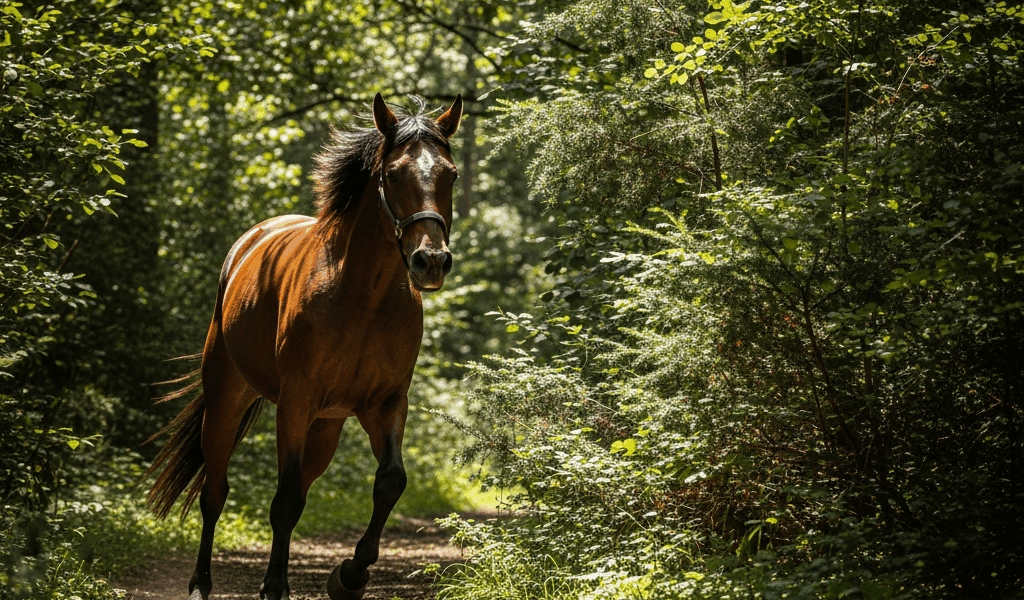
Why Your Horse Is Spooking and When It Actually Matters
Horse spooking has gotten complicated with all the conflicting advice flying around. Desensitize more. Desensitize less. It’s a training problem. It’s a pain problem. It’s you. Everyone has an opinion, and half of them will point you in the wrong direction. For the broader diagnostic framework, see why a horse keeps spooking and how to respond safely.
Here’s the honest truth: not all spooks are created equal.
A healthy horse will occasionally startle. That’s just prey animal wiring doing its job. A leaf skitters across the trail, a bird explodes out of a bush, somebody’s water bottle hits the ground — and your horse jumps sideways or slams on the brakes. You breathe. You ask him forward. Thirty seconds later you’ve forgotten it happened. That’s normal. That’s Tuesday.
But when the spooking happens at the same spot every single ride? When it’s getting worse instead of better? When your horse is rearing rather than shying, and you’re genuinely calculating your odds of landing in the dirt — that’s a pattern worth taking seriously.
The real problem is that spooking has multiple root causes, and throwing the wrong solution at it wastes months. Desensitization exercises won’t fix a horse with gastric ulcers. Two weeks of flag work won’t help if your saddle is pinching his withers. Before you build a training plan, you need to know what you’re actually dealing with.
Is this a young horse still learning to trust you? A horse in pain who’s gotten defensive? A vision issue you haven’t caught yet? Or — and this one stings a little — is the spooking escalating because of what you’re doing in the saddle?
The next four sections walk through the diagnosis and fix in a specific order. Start with the physical checks. Move to desensitization. Then take a hard look at yourself. That sequence matters — don’t skip ahead.
Check for Pain and Equipment Issues First
Probably should have opened with this section, honestly. I’ve watched riders spend three, four, five months trying to train out spooking that turned out to be a saddle fit problem or undiagnosed ulcers. The horse wasn’t being difficult. He was hurting.
Rule out the physical stuff before you do anything else.
Saddle Fit and Back Soreness
A saddle that pinches, sits too far forward, or concentrates weight unevenly will make a horse tense and reactive — sometimes dramatically so. Start with a quick check: saddle on, no pad. Can you fit two fingers under the pommel at the withers? Run your hand under the panels along his side. Any resistance? View the saddle from directly behind. Does it sit level, or does it tip?
Then run both hands slowly down either side of his back. Feel for heat, tight muscles, or flinching. A horse with a sore back is already operating with his nervous system near its limit. Something as minor as a leaf blowing past can tip him over the edge.
If saddle fit looks suspicious, get a fitter out. Consultations typically run $75 to $150 — sometimes a bit more depending on where you are. I know that sounds like a lot until you factor in the time you’ll burn trying to train around a problem that has nothing to do with training.
Vision Problems
Horses with partial vision loss or asymmetrical vision will spook hard and consistently — but almost always on one side. They’ll balk at trail obstacles that appear on the affected side, shy dramatically, or refuse to pass certain things at all.
Try this: stand about six feet off your horse’s left shoulder and slowly move your open hand toward his eye. Does he blink? Does his eye track your movement? Repeat on the right. A horse that doesn’t respond on one side needs a veterinary eye exam, not a desensitization program.
Gastric Ulcers and Digestive Discomfort
But what is an ulcer-prone horse, behaviorally speaking? In essence, it’s a horse who looks spooky but is actually just in pain and defensive. But it’s much more than that — ulcers create a baseline anxiety that makes everything feel more threatening.
Watch for: sensitivity when you tighten the girth, reluctance on downhill terrain, a coat that looks dull even in good condition, and a general grumpiness about trail work that wasn’t there six months ago. High-grain diets, long gaps between feedings, and heavy training schedules all raise ulcer risk.
A vet can scope the stomach for roughly $400 to $600 depending on your region. Expensive, yes. Less expensive than six months of training sessions that accomplish nothing because the underlying problem is still there.
Tooth or Mouth Pain
Less common, but worth a mention. Sharp enamel points, a loose tooth, or TMJ discomfort will make a horse brace against the bit — and a horse that’s bracing is a horse that’s already tense before you even hit the trail. Ask your vet to check his mouth during the next wellness visit. Most can spot issues without a separate appointment.
Once you’ve cleared the physical stuff — or identified and started treating it — then you can move to training.
How to Desensitize a Spooky Horse Step by Step
Desensitization works. It takes consistency and some patience, but it genuinely works. The goal is controlled exposure — your horse encounters the scary thing in a setting where nothing bad actually happens, enough times that his nervous system stops filing it under “threat.”
The one principle you cannot skip: work below threshold. Threshold is the point — in distance or intensity — where your horse tips from noticing into panicking. If he loses it over a plastic bag at 50 feet, you start your work at 80 feet. He sees the bag. He’s mildly curious or mildly tense. He doesn’t bolt. That’s your working zone. You build confidence there before you ever move closer.
Step 1: Start on the Ground at Home
Gather whatever is actually spooking your horse — plastic grocery bags, a blue tarp, pool noodles, orange traffic cones, a flapping flag. Set them around the perimeter of your arena or roundpen, well away from your working path.
Lead him around. When he notices one of the objects, stop. Let him stand and look as long as he needs to. Don’t drag him forward. Don’t retreat. When he exhales or drops his head even slightly, reward him — a quiet scratch, a verbal “good,” a step forward he chose himself. Calm observation is the goal, not physical proximity. Plan on three to five sessions before moving to step two.
Step 2: Introduce Movement and Sound
Once he’s standing quietly near the stationary objects, add motion. Gently rustle the plastic bag. Drop a stick near the tarp. Shake the pool noodle lightly. Not aggressively — just enough to create stimulus. When he startles, stay still, wait for him to settle, then reward the settle. That’s the rep.
Keep sessions to five or ten minutes. Work every other day, not every day — he needs time to process between exposures.
Step 3: Desensitize Under Saddle
Mount up and walk past the objects at distance. When he handles that calmly, move the next ride’s path a few feet closer. This step usually takes two to three weeks — sometimes longer depending on the trigger and how established the spooking pattern already is.
Step 4: Take It to the Trail
Now you have history. Your horse has seen this type of object — or something similar — multiple times and survived every single encounter. His nervous system has context. On trail, when something comparable appears, his baseline reaction will be lower. Not zero, necessarily. Lower. That’s the win.
Desensitization doesn’t erase spooks permanently. It makes them shorter, smaller, and far less dangerous. That’s what makes consistent groundwork so valuable to us trail riders — it compounds over time.
What You Are Doing in the Saddle That Makes It Worse
This is where most articles just stop. They cover desensitization and call it a day. That’s incomplete — and honestly a little frustrating, because rider behavior is often half the problem.
Your body in the saddle is communicating with your horse constantly. When you grip your legs, stiffen through your seat, or suck in a sharp breath, he feels all of it. His nervous system reads your tension as confirmation: yes, that thing over there actually is dangerous. You’re essentially casting a vote, with your entire body, that the scary object deserves to be scary.
Leg gripping is the classic mistake. You get nervous — completely understandably — and you clench. Your horse interprets that leg pressure as a cue to accelerate or brace. He gets more reactive. You get more anxious. The loop feeds itself.
I’m apparently a breath-holder under pressure, and conscious exhaling works for me while just “trying to relax” never does anything. Don’t make my mistake. Start practicing deliberate breathing before you ever encounter a trigger. Walking down a quiet stretch of trail — inhale for a count of four, exhale for a count of six. Then when something spooks your horse and panic spikes in your chest, your first trained response is to push air out rather than hold it in.
Second fix: soften your legs intentionally. Picture your heel as heavy, your calf as loose. When the spook happens and every instinct says grip — don’t. Use a half-halt instead. Brief closing of seat and hands, released immediately. It rebalances him without adding tension to the situation.
Third fix — and this one surprised me when I first heard it: stop staring at the scary object. Horses read eye contact and head position. If your gaze is locked onto the flapping tarp, your horse knows exactly where your attention is. Look past it. Pick a point down the trail. Plan the next three strides. Your attention tells him the thing is just scenery, not a predator.
I learned this the hard way with a jumper — a 16.1-hand gray Warmblood — who started spooking at fences mid-course. The more I fixated on the jump, the worse his approach got. The week I forced myself to keep my eyes up and trust the striding I’d already established, he settled completely. Same horse. Same jumps. Different rider energy. Completely different results.
When the Spooking Is Not Getting Better
Three to four weeks of consistent work — physical checks done, desensitization underway, rider habits improving — and most spooking patterns start to shift. If yours isn’t moving in the right direction, something else is in play.
Red Flags That Need Professional Help
Escalating reactivity. If your horse is spooking harder, from farther away, at more things each week, this is not a training deficit. Call your veterinarian first. Then find a trainer who specifically works with behavioral issues — not just a general riding instructor.
One-sided spooking. Consistent spooking only on the left, or only on the right — that’s a vision or pain indicator, full stop. Get a vet evaluation before you set foot in the saddle again for trail work.
Rearing instead of shying. A horse that rears when startled is in a different risk category than a horse that jumps sideways. This warrants professional handling. Don’t push through it alone.
Explosive behavior. Bolting, violent spinning, bucking after a spook — this has moved well past normal reactivity into genuinely dangerous territory. Work with an experienced trainer in person. Not videos, not articles. In person.
Timeline and Realistic Expectations
A young horse who’s just green and inexperienced might turn a corner within two to three weeks of steady exposure work. An older horse with a well-established spooking habit — four, five, six years of the same pattern — might need six to eight weeks before you see meaningful change. A horse who was ulcer-positive and just finished treatment? Expect four to six weeks post-treatment before his behavior really shifts. The gut healing takes time.
Progress isn’t a straight line. Your horse might handle five rides beautifully, then lose it at something new and seem like he’s back at square one. He’s not. He encountered a new variable. That’s different from regression. Stay consistent — that’s the only variable you fully control.
Most spooking can be managed and genuinely minimized. Very few horses are actually unsuitable for trail work — the number is much smaller than people assume. But fixing it requires honesty about what’s actually causing it and consistency in how you respond. That’s the work. There’s no shortcut around it.

Leave a Reply