Horse Keeps Refusing Jumps — What Is Actually Wrong
Jumping refusals have gotten complicated with all the conflicting advice flying around.
Refusals almost never trace back to one clean reason. They’re a symptom. Four root causes account for nearly every stop I’ve ever seen, and if you don’t identify which one you’re dealing with, nothing else you try will actually stick. The fastest path forward isn’t more schooling. It’s elimination. Rule out physical pain first. Then training gaps. Then your own riding. Then the jump itself. Do it in that order.
First Rule Out Pain Before Anything Else
This has to be your starting point. A horse refusing jumps is often a horse in pain. Not always dramatic, obvious pain — sometimes just enough discomfort that jumping feels wrong.
Back Soreness and Saddle Fit
Run your palm flat across your horse’s back, pressing firmly along both sides of the spine. A sore horse flinches. Pins ears. Steps sideways. Check the girth area too — sensitivity there often signals a problem before you ever reach the first fence.
Saddle fit is worth examining even when it looks fine. I’ve personally watched a $3,400 custom saddle cause refusals because it shifted forward maybe half an inch over a winter. Have a fitter evaluate it. Costs around $150–$300 depending on your area, which beats three months of missed jumping and mounting frustration. If the saddle presses unevenly or loads the wrong part of the spine, your horse stops because jumping genuinely hurts him.
Ask yourself: does he move differently on the flat when loose versus under saddle? Cross-canter? Feel stiff tracking left? Both are red flags worth taking seriously.
Hock and Stifle Issues
Hock soreness is quietly responsible for a huge percentage of refusals nobody ever correctly diagnoses. A lame horse gets noticed immediately. A horse that’s just reluctant to engage his hindquarters and push off? That one gets labeled lazy. Nappy. Difficult. Don’t make my mistake.
Watch him move in a circle at trot and canter both directions. Does he hesitate loading one hind leg? Does the stride shorten going right but not left? Those are your candidates for a vet call. Hock injections run roughly $400–$800 per joint — not cheap — but they solve jumping refusals that look exactly like behavioral problems.
Stifle issues present a bit differently. More forehand loading, less power behind, occasional stumbling on landing. Also needs a vet. Not something to guess at.
Bit Pressure and Mouth Pain
A sharp, sudden refusal pattern — especially one that started after a bit change or at a specific height — sometimes traces back to the mouth. Check for cuts, sores, or uneven molar edges. Floating is honestly underrated as a refusal fix. Uneven molars create uneven bit pressure, and some horses would simply rather stop than deal with it every stride.
When to call the vet: if he’s sound on the flat but stops at fences consistently, if he shows girth or back sensitivity, or if the refusals appeared suddenly rather than creeping up gradually. Basic exam runs $100–$200. Worth every cent if it saves you four months of spinning your wheels.
Training Gaps That Set Horses Up to Refuse
Probably should have opened with this section, honestly. Pain is real, but training gaps are genuinely more common. A horse rushed to height, never properly introduced to fillers, or never taught a consistent approach will refuse. That’s not attitude. That’s an incomplete education.
Rushing to Height Too Fast
This is the one I see constantly. Horse jumps 2’6″ beautifully on a good Tuesday. Rider decides he’s ready for 3′. Three days of 3′ work later, he’s stopping cold at the base. He’s not being difficult — his training just isn’t there yet.
Build height in small increments. Solid, confident 2’0″ rounds before moving to 2’3″. Then two full weeks at 2’3″ before touching 2’6″. That’s not slow — that’s how muscle memory and genuine confidence actually get built. Skip the steps, and the horse loses faith in both the fence and himself. That’s what makes systematic height progression endearing to us as a training philosophy rather than just caution for caution’s sake.
Inconsistent Approach Lines and Canter Rhythm
Horses don’t like guessing. A horse with no reliable takeoff spot is a horse that will eventually just stop rather than keep gambling.
Walk a consistent 12-foot stride on a 20-meter circle before introducing jumps into a schooling session. Teach rhythm first. Every refusal I’ve debugged at a friend’s barn — and I’ve stood ringside at probably a dozen of these over the years — came down to the canter quality in the final three strides. Rider lets it get quick or flat, horse stops, rider puzzles over “why he’s being so naughty today.” Fix the approach. The refusal usually disappears within a session.
Spend more time on the flat than over fences. Sounds completely backwards. It isn’t.
Never Properly Introduced to Fillers and Colored Poles
But what is a “filler problem,” exactly? In essence, it’s a horse refusing something visually unfamiliar rather than refusing jumping itself. But it’s much more than that — it’s a gap in systematic exposure that should have been filled early in training.
Approach at a walk. Let him look at the bright blue panel or the flower boxes or whatever triggered the stop. Walk over ground poles in different colors. Trot over them. Build to a small crossrail with a simple filler underneath. Make it completely boring before you make it a question. Takes a few sessions, not months.
Rider Habits That Teach Horses to Stop
Here’s the section most articles quietly skip because it’s uncomfortable. Every rider has done this. I’m apparently the type who ducks ahead on the approach, and working without stirrups for six weeks is what fixed me while just “thinking about it” never did anything useful.
Ducking Ahead Too Early
Jump ahead of the motion instead of with it, and your horse loses support exactly when he needs it most — at takeoff. He feels unbalanced. He learns jumping is unstable. Result: refusal next time, and the time after that.
Record yourself. Get someone on the ground with a phone. Watch where your seat is at three strides out versus at the actual moment of takeoff. Already in two-point three strides before the fence? That’s the problem right there. Stay with your horse. Let him find the distance.
Dropping Contact Before the Jump
Three strides out and the hands dive forward, reins go slack. Your horse loses his guideline at the worst possible moment. He doesn’t know if you want jump, stop, or something else entirely — so he chooses stop. Maintain consistent contact through the whole approach. Not harsh. Consistent. That connection is how he balances and meets the fence correctly.
Looking Down
Stare at the base of the jump instead of ahead to the next fence, and your horse reads the weight shift through your seat and assumes something is wrong up ahead. Horses process rider information through the seat and the leg constantly. Look where you’re going. Ride forward.
Inconsistent Leg at the Base
Leg that disappears three strides out tells him to slow down. Leg that suddenly fires at the last second surprises him. Neither works. Steady leg, steady contact, steady eyes forward — that’s the combination that produces a horse who trusts the question being asked.
Video yourself before assuming behavior. Most refusal patterns that look like attitude problems turn out to be position problems on replay. That’s not a criticism. It’s just the fastest way to fix it.
Environmental Triggers Most Riders Overlook
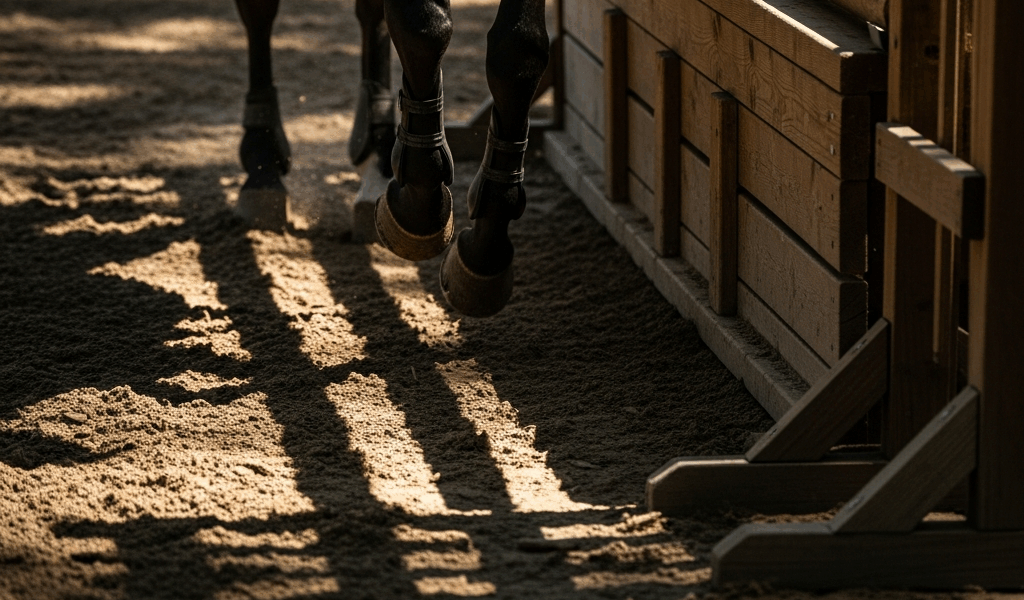
Shadows cutting across a fence at 4pm. A filler rattling in the wind. Footing that changes texture three strides out from the base. These things matter more than most riders give them credit for.
A genuinely frightened horse looks different from a horse that has learned stopping gets him out of work. Fear looks like slow, cautious approaches — maybe a rear, wide eyes, real hesitation. Avoidance looks decisive. He stops cleanly and immediately starts looking for another direction.
For environmental spookiness, desensitize without force. Let him look. Walk the approach multiple times without asking for the jump. Expect the process to take longer than feels comfortable. That’s normal. Punishing a scared horse confirms the fear — every time, without exception.
For jump placement specifically, check footing consistency, light quality at different times of day, and whether the fence sits near a spooky corner or wall. Move your schooling jumps around. A horse that stops cold at the far end of the arena might jump the exact same fence confidently in the middle. That tells you everything.
How to Rebuild Confidence After a Refusal Pattern Starts
Once you’ve ruled out pain and identified the actual cause, rebuild systematically. So, without further ado, let’s dive in.
Start low. Poles on the ground. Crossrails at 18 inches. The horse needs to remember that jumping is possible and safe before height means anything. Expect two to four weeks of this, depending on how deeply the refusal pattern has set in.
End every single session on a successful repetition. A good jump over something small should be the last question you ask. He goes home thinking about the win, not the stop. This sounds small. It compounds fast.
Never punish after a refusal. I’ve watched riders go hard on their horses after stops — crop, voice, the works. Every single time it made the refusals worse within a week. Anxiety creates hesitation. Hesitation becomes refusal. You’ve just built a cycle that’s now twice as hard to undo.
Three to four sessions per week if your schedule allows. Consistency is what rebuilds trust. Sporadic schooling drags the whole process out by weeks.
Be patient. A horse that’s refused repeatedly needs time to genuinely believe it’s safe again — not just time to comply. You can’t force that belief. You build it, one small positive rep at a time.

Leave a Reply