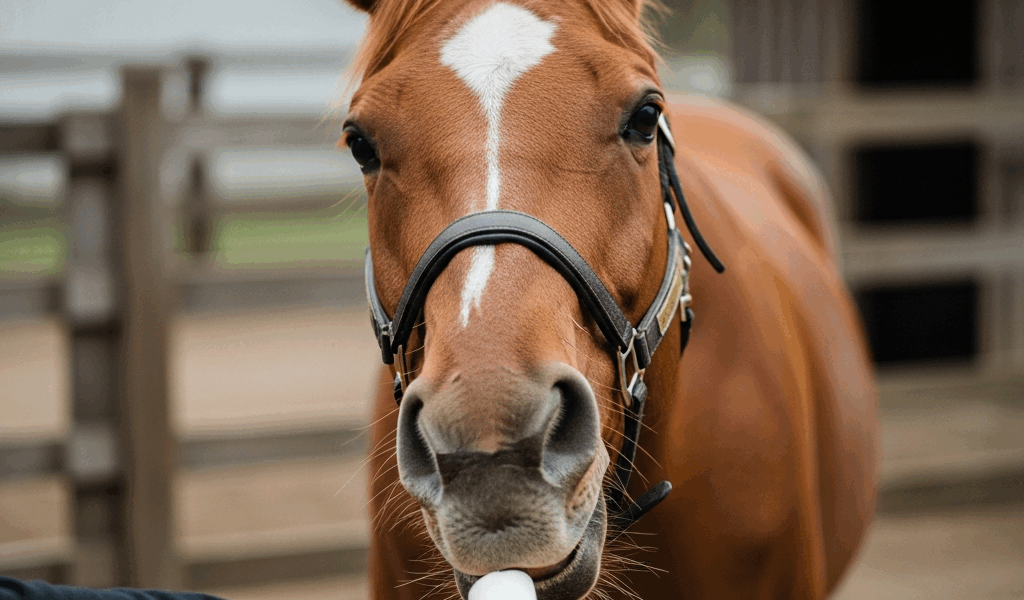
Can Horses Safely Eat Marshmallows?
Can horses eat marshmallows? Yes — plain marshmallows are safe for most horses in very small amounts. I learned this the hard way at a trail ride campfire last summer when my mare, Dolly, stuck her nose directly into the bag of Jet-Puffed I had sitting on my camp chair. Full panic mode. I was frantically searching on my phone with one hand and trying to count how many she’d grabbed with the other. Spoiler: she was fine. But that moment sent me down a research rabbit hole that I wish had been easier to find.
Here’s the short version for anyone in that same situation right now: one or two plain marshmallows is not an emergency. Step away from the phone-call-to-the-vet ledge. That said, there are two real risks you need to know about immediately — the sugar load and the choking hazard. Both are manageable. Neither should be ignored.
Plain marshmallows contain gelatin, sugar, corn syrup, and vanilla. No xylitol in the standard varieties, which is the ingredient that makes certain sweets actually toxic to animals. Brands like Kraft Jet-Puffed and Campfire Marshmallows use standard sugar — not sugar alcohols — so you’re not dealing with a poisoning situation. What you are dealing with is a high-glycemic, sticky, pillowy blob that your horse has zero evolutionary reason to be eating.
Flavored marshmallows, chocolate-dipped marshmallows, or anything from a specialty candy shop — those are a hard no. Stick to the plain white ones and keep the quantity controlled.
How Many Marshmallows Can a Horse Have?
Probably should have opened with this section, honestly, because this is what most people need when they’re standing at a campfire watching their horse sniff the s’mores supplies.
The working number I follow is two to three small marshmallows per week — and that’s the ceiling, not the goal. A single standard Jet-Puffed marshmallow weighs about 7 grams and contains roughly 4.1 grams of sugar. For context, one medium carrot contains about 2.9 grams of sugar. So one marshmallow already outpaces a carrot on sugar. Two marshmallows in a single sitting puts you around 8 grams of sugar from treats alone, before you factor in anything else your horse ate that day.
A 1,100-pound horse in moderate work can handle some dietary sugar — but treat sugar stacks on top of hay sugars, grass sugars, and any grain in the diet. It adds up faster than people think.
Serving Guidelines That Actually Make Sense
- Maximum two to three small marshmallows per week, not per day
- Cut each marshmallow into quarters before offering — more on why in a moment
- Never dump a handful from the bag directly into your hand and let your horse vacuum them up
- Offer one piece at a time so you can watch your horse chew and swallow between pieces
- Do not make marshmallows a regular training treat — find a lower-sugar option for daily use
The math on a whole bag is genuinely alarming. A standard 10-ounce bag of Jet-Puffed contains about 40 marshmallows and roughly 165 grams of sugar. Feeding that to a horse in one sitting would be roughly equivalent to dumping a third of a cup of pure table sugar into their feed bucket. Nobody would do that intentionally — but people hand out treats at campfires without thinking twice about the cumulative amount.
Which Horses Should Never Eat Marshmallows
For a healthy horse with no metabolic conditions, a marshmallow or two is a low-stakes indulgence. For certain horses, it is genuinely off the table. Full stop.
Equine Metabolic Syndrome
Horses diagnosed with Equine Metabolic Syndrome (EMS) have chronically elevated insulin levels and impaired ability to regulate blood glucose. Any spike in dietary sugar — even from a single marshmallow — can trigger a cascade of hormonal dysfunction. I spoke with my vet about this specifically when a friend’s horse was diagnosed, and she was unambiguous: sugar treats are not a sometimes food for EMS horses. They’re not a food at all.
Insulin Resistance
Insulin-resistant horses are frequently managed on low-sugar, low-starch diets with forage that’s been tested and sometimes soaked to reduce water-soluble carbohydrates. Handing one of these horses a marshmallow — even with good intentions — undermines careful dietary management. If your horse is on a Purina Enrich Plus or similar low-NSC feed program because of insulin resistance, marshmallows contradict everything that diet is designed to do.
Cushing’s Disease (PPID)
Horses with Pituitary Pars Intermedia Dysfunction, commonly called Cushing’s disease, are at elevated risk for laminitis and often have concurrent insulin dysregulation. Many are managed with pergolide (Prascend) alongside strict dietary controls. Sugar treats — marshmallows included — are contraindicated for most PPID horses, particularly those with any history of laminitis.
Laminitis-Prone Horses
If your horse has had even one laminitis episode, you already know that dietary sugar management is non-negotiable. Laminitis involves inflammation of the laminae inside the hoof — the tissue connecting the hoof wall to the coffin bone. Recurring episodes can cause rotation or sinking of the coffin bone. No marshmallow is worth that risk. Not one.
When in doubt about your horse’s metabolic status, ask your vet before introducing any treat outside your horse’s established diet. That’s not an overreaction — it’s basic management for horses with complicated histories.
Choking Risk — Cut Them Small
Here’s the thing about marshmallows that surprised me: they’re not hard, so people assume they’re automatically safe. They’re not. Marshmallows are soft and sticky — and that combination is actually more problematic than something firm and dry like a carrot chunk.
Struck by how casually people toss whole marshmallows to horses at trail camps, I started paying closer attention to how horses actually eat them. A horse that grabs a whole standard marshmallow may compress it between their lips and molars, creating a dense, adhesive plug. If they try to swallow before it’s broken down enough, that sticky mass can lodge in the esophagus — which in horses runs along the left side of the neck and is relatively easy to block.
Esophageal choke in horses is not the same as airway choking in humans — horses can still breathe during an esophageal obstruction. But it is a veterinary emergency. Signs include distress, neck stretching, excessive saliva, nasal discharge of food material, and repeated swallowing attempts. A choke that doesn’t resolve on its own requires a vet to pass a nasogastric tube and flush the obstruction. That’s a barn call that costs between $200 and $500 depending on your location and whether it’s an after-hours emergency.
The fix is simple. Cut marshmallows into quarters. A standard Jet-Puffed marshmallow cut into four pieces gives you small, manageable bites that a horse can chew and swallow without difficulty. Takes about five seconds with a pocket knife. Do it every time.
Better Treat Alternatives
Marshmallows are a campfire impulse decision — not a treat you’d ever put on your regular grocery list for your horse. If you’re looking for something your horse actually loves that isn’t riding a sugar spike, you have better options.
Quick Sugar Comparison — Common Horse Treats
| Treat | Serving Size | Approximate Sugar |
|---|---|---|
| Marshmallow (plain, Jet-Puffed) | 1 whole (7g) | ~4.1g |
| Baby carrot | 1 medium (15g) | ~1.5g |
| Apple slice | 1 slice (30g) | ~3.2g |
| Peppermint candy (standard) | 1 piece (6g) | ~5.4g |
Carrots are the obvious winner here — lower sugar, satisfying crunch, and horses go absolutely feral for them. Read our full breakdown on feeding carrots to horses for portion guidance and how to prep them safely.
Apples are a classic and horses love them, though the sugar content is similar to marshmallows by weight — so they’re not a free-for-all either. Our apples article covers the coring debate and variety differences.
Peppermints — the red-and-white kind — are a barn staple and most horses consider them a controlled substance. The sugar content is actually higher than a marshmallow, which surprises people. See our peppermint piece for the full story on those.
For horses that need genuine low-sugar treat options — metabolic horses, easy keepers, anyone on a restricted diet — plain hay cubes (Timothy or orchard grass) make an underrated reward. No sugar math required, no guilt, and horses will work just as hard for them once they’re used to getting them as reinforcement.
The bottom line: marshmallows are not poison, and one campfire moment of your horse stealing a couple is not going to cause lasting harm to a healthy horse. But they’re not a treat to keep in the tack room, and they’re not something to share without thinking. Cut them small, keep the quantity at two or three per week maximum, and know your horse’s metabolic history before you offer anything sweet. That’s the whole answer.




Leave a Reply