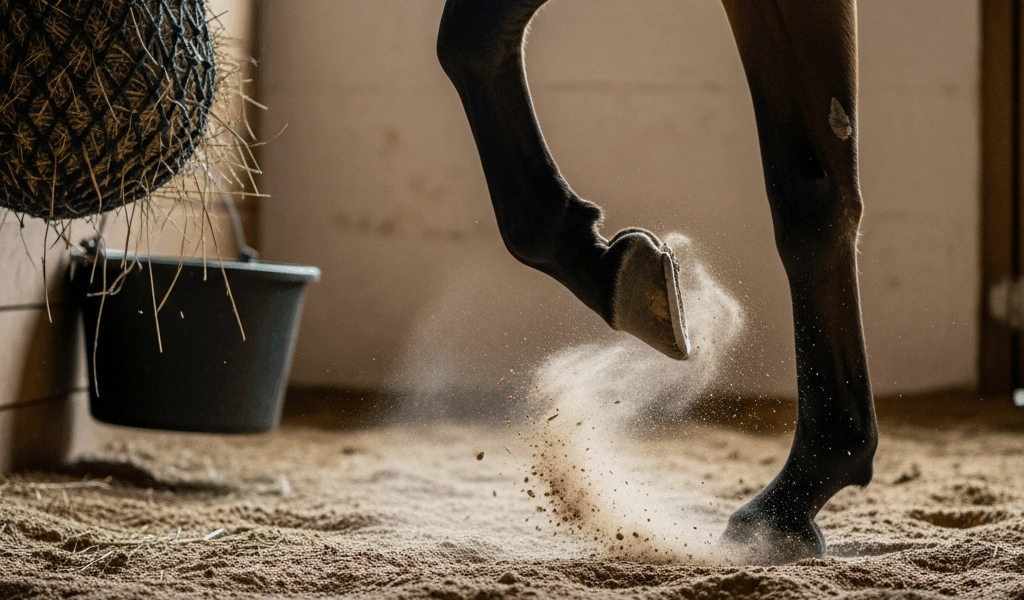
Horse Keeps Pawing the Ground — Causes and Fixes
Horse pawing has gotten complicated with all the generic advice flying around. Every article says “redirect the behavior” or “stay consistent,” and somehow none of it actually stops the noise rattling through your barn at 4:50 p.m.
Here’s the part most people skip: the fix depends entirely on when and where it’s happening. A horse pawing at the feed bucket is a completely different problem from one pawing while tied or digging craters in a stall. Don’t make my mistake — I spent three weeks applying the wrong solution to the right horse and got absolutely nowhere.
Why Horses Paw and What It Actually Means
But what is pawing, really? In essence, it’s communication. But it’s much more than that.
Impatience is the big one. A horse that paws and gets a result — the gate swings open, grain lands in the bucket, you stop whatever you’re doing — files that away immediately. That’s what makes horses endearing to us as owners and infuriating in equal measure. They’re fast learners. Anticipation feeds the cycle too. My mare started at 4:48 every single evening. You could set a watch by it.
Frustration and boredom run parallel. Confinement, separation from herd mates, two flakes of hay and nothing else to do — these create restlessness that comes out through the front feet. It’s not spite. It’s just energy with nowhere to go.
Pain or discomfort changes the picture entirely. Ulcers, lameness, early colic — these make horses paw for reasons that have nothing to do with manners or training. You cannot train your way out of a medical problem. That distinction matters more than anything else in this article.
Learned behavior is the final category. If pawing has worked even once — even accidentally — it’s a viable strategy now. Horses are nothing if not persistent record-keepers.
Pawing While Tied or at the Hitching Post
This is probably why you’re here. So, without further ado, let’s dive in.
Here’s the reinforcement trap most people fall into without realizing it. Horse paws. You react — shift your weight, touch the lead rope, say something, literally anything. Horse pauses for three seconds. You think it worked. It didn’t. Your horse just learned that pawing generates attention, and attention is worth the effort. Next session, it paws harder and longer before pausing.
The fix is counterintuitive. Ignore it completely — at least if you can stomach standing fifteen feet away pretending to check your phone while your horse excavates the hitching area. When it stops and stands still, even five seconds at the start, walk over quietly and reward. Treat, soft word, brief scratch. That teaches the inverse: stillness pays. Pawing brings absolutely nothing.
Run through this ten times over several days. Extend the required standing time before you reward — five seconds becomes fifteen becomes a full minute. Most horses connect the dots within a week. Some take two. Either way, it works.
Two practical adjustments help the process. First, tie lower — a rope at chest height gives less leverage and fewer ways for the behavior to self-reinforce through tension in the line. Second, a patience pole is worth considering. A short post, roughly four feet tall, with a 36-inch lead removes a lot of the visual drama and limits how much power each paw actually generates. They run about $40 to $80 depending on brand. Cheaper than replacing fence boards every spring.
One critical note — and I mean critical. If your horse paws despite solid training history, check for pain first. Ulcers make standing still genuinely uncomfortable. Lameness does the same thing. A vet visit solves what a training session cannot.
Pawing at Feeding Time
Probably should have opened with this section, honestly, because it’s the most common complaint I hear.
Here’s the sequence: you walk toward the stall with the grain bucket. Horse paws. You pick up the pace to make the noise stop and toss the feed in. Done. Except now you’ve paid for pawing. Congratulations. You’ve just enrolled in a program that runs indefinitely.
Break the pattern with one non-negotiable rule: four hooves on the ground, standing still, before any feed hits the bucket. No exceptions — not on bad days, not when you’re running late, not when the pawing is especially loud. This means standing in the aisle holding a $28 bag of senior feed while your horse cycles through every dramatic behavior in its repertoire. Eventually it will stand quiet for a few seconds. That’s the window. Feed immediately.
First session: roughly fifteen minutes. Second session: closer to ten. By day three, most horses figure out that stillness is the mechanism, not pawing. The behavior drops off fast once the equation shifts.
Varying feeding time also helps — at least if your horse is the type that starts anticipating twenty minutes early. Shift your 5:00 p.m. feed to 5:14 for a week. Then 4:51 the week after. Randomness within a reasonable window disrupts the schedule-based anticipation cycle. The pawing has nothing to lock onto.
Pawing in the Stall or Paddock
Stall pawing is different. It lives in its own category.
Situational pawing happens when a horse is waiting for something specific — turnout, a meal, a companion returning. Normal. Usually self-correcting once the trigger resolves.
Compulsive stall pawing is something else entirely. Rhythmic, repetitive, detached from any obvious trigger. That’s stereotypy — a stress response rooted in confinement. Management can reduce it. Rarely eliminates it completely. If you’re dealing with this, be honest with yourself about what “fixed” actually means here.
For both types, the approach is the same: more forage, more turnout, slow feeders. A horse working through a small-hole hay net eats across eight to ten hours instead of two. That’s eight fewer hours of boredom looking for an outlet. A companion animal helps too — a goat, a mini donkey, another horse. Isolation is expensive in ways that show up in behavior before anything else.
Check your stalling hours. Twelve hours confined is where the problem starts. Sixteen hours nearly guarantees pawing, weaving, or something worse. I’m apparently a slow learner about this — I kept adjusting training techniques for months before someone finally asked how long my mare was stalled each day. The answer was embarrassing. Twelve to fourteen hours, most days. That was the problem.
When Pawing Signals a Health Problem
Sometimes pawing isn’t a behavior issue. It’s pain wearing a behavior costume.
Colic is the emergency. Pawing alongside sweating, flank-watching, food refusal, or rolling — that’s a call-the-vet-right-now situation. Not in thirty minutes. Not after you finish your coffee. Now. Colic can become fatal in hours. Don’t wait to see if it resolves.
Ulcers show up as feeding-time pawing because stomach acid spikes when a horse smells food coming. The pawing is a stress response to that discomfort, not impatience. Other signs layer in — dull coat, dropping weight, a general shift in attitude. Gastroscopy confirms it. Omeprazole — GastroGard runs about $30 to $40 per tube — works well alongside dietary changes, but diagnosis has to come first. Don’t just treat blind.
Lameness or hoof pain can read as pawing, especially in stalls where a horse shifts weight constantly trying to find a position that doesn’t hurt.
The working rule: new pawing, pawing paired with any other symptom, or pawing that happens every single day regardless of context — that’s a vet conversation. Behavioral pawing tied to specific situations — tied horses, feeding time, stall boredom — responds to training and management. The difference between those two categories matters more than any specific technique.
Your horse keeps pawing the ground for a reason. Match the situation to the solution — actually match it, not just apply the first fix you read about — and you’ll get somewhere. That’s what makes this problem solvable for most owners once they stop treating all pawing as the same thing.

Leave a Reply