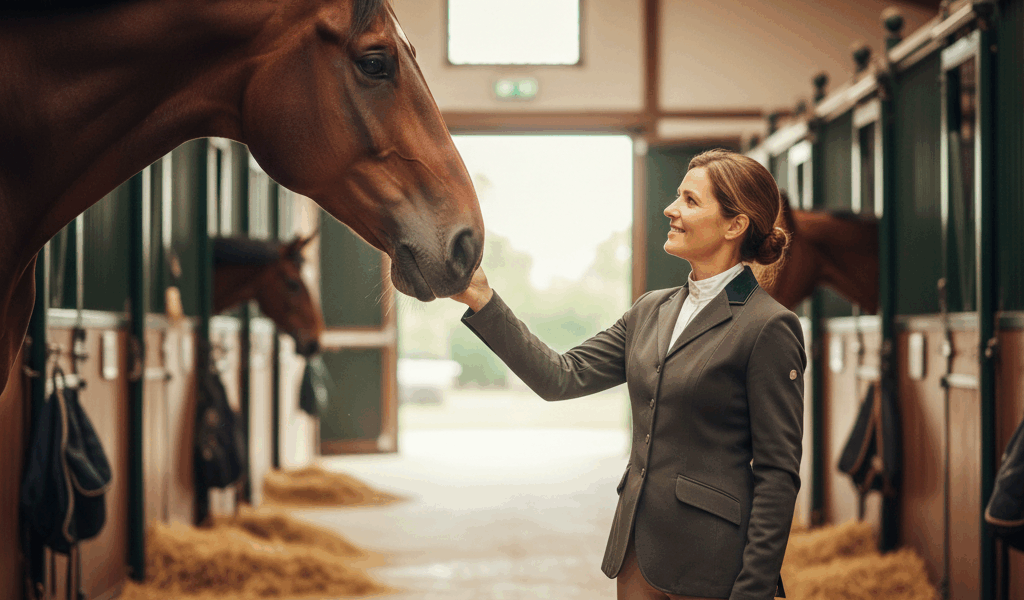
Yes, horses can recognize familiar individual people. Research indicates that horses use more than one cue: they can discriminate human faces, connect a familiar person’s appearance with that person’s voice, and learn expectations from repeated interactions. What science does not support is treating every nicker, approach or calm response as proof of a human-style emotional story.
“Owner” is also not a special biological category. A horse may recognize an owner, rider, groom, trainer, veterinarian or feeder as a familiar individual. The strength and meaning of the response depend on the history and context of those interactions.
What recognition means
Recognition means the horse distinguishes one person from another and retrieves information associated with that individual. That information might include voice, face, movement, smell, routine, handling style, location and past consequences.
Recognition is not the same as:
- Obedience to a cue
- Approaching because a person carries food
- Feeling safe with every familiar person
- Showing an attachment identical to a dog or human relationship
- Understanding the legal concept of ownership
A horse can recognize someone and still avoid that person because of pain, fear, conflicting training or a negative interaction history.
Evidence that horses recognize human faces
Controlled research has shown that horses can learn to discriminate photographs of individual human faces. A 2020 study reported evidence that horses processed human faces as faces rather than merely as unrelated two-dimensional patterns. The researchers tested recognition when visual properties were changed, supporting a more holistic form of face processing.
The important takeaway is not that a horse identifies a face exactly as a person does. It is that facial information can be one component of individual human recognition.
Horses can combine a face and voice
Recognition is stronger when several senses agree. Cross-modal studies examine whether an animal connects information arriving through different senses. Work with horses has found evidence that they match a familiar person’s visual identity with that person’s voice and show greater attention when the cues do not match expectations.
This helps explain why a horse may identify a familiar handler before the person is close enough for one single cue to dominate. Voice, outline, movement, routine and other information can work together.
Does a horse recognize your smell or footsteps?
It is plausible that smell, gait and characteristic sounds contribute, but owners should be careful about attributing one exact cue without a controlled test. The sound of a truck, a feed-cart schedule, a gate opening or barn activity may predict food or turnout even when the horse has not identified the individual person yet.
Recent research also indicates that human emotional odors can influence horse behavior and physiology, showing that olfactory information matters in horse-human interactions. That finding does not establish that scent is always the primary identity cue.
Do horses remember former owners?
Horses have demonstrated memory for familiar human faces after periods without contact, so recognition after a separation is possible. The likelihood of an observable response will vary with the relationship history, length of separation, context and competing cues.
A subdued reunion does not prove the horse forgot. A dramatic reunion does not by itself prove a specific emotional interpretation. Behavior should be evaluated across repeated, comparable situations.
Recognition versus preference and bonding
A horse may recognize multiple handlers but prefer approaching or remaining near one. A 2026 study using an adapted “strange situation” test reported behavioral evidence of partner-specific preference for a rider. Other studies have produced more mixed findings about attachment-like behavior, so the safest conclusion is that some horse-human relationships become individual-specific without assuming all horses form the same kind of bond.
Familiarity alone is not necessarily positive. Predictable gentle handling may create positive expectations, while rough or inconsistent handling may create avoidance. Read our guide to building trust with a horse for practical, welfare-centered interaction principles.
Signs your horse may recognize you
Possible signs include orientation toward your voice, approaching you when several people are present, changing behavior when you take over handling, or anticipating a routine associated specifically with you. None is conclusive in isolation.
Look for patterns:
- The response occurs repeatedly rather than once
- The horse distinguishes you from another familiar person
- The response persists when obvious food cues are absent
- Voice and visual cues produce consistent orientation
- The horse’s whole body remains compatible with the interpretation
Ears forward do not automatically mean affection, and a nicker does not identify its cause. Use our horse body-language guide to interpret posture, muscle tension, movement and context together.
A simple observation exercise
You cannot reproduce a controlled cognition study at the barn, but you can reduce obvious confounds:
- Choose a calm, familiar environment.
- Do not carry feed or use a feeding-time routine.
- Have two familiar people stand at similar distances with neutral posture.
- Avoid prompting, calling, reaching or staring.
- Record initial orientation, approach and time spent nearby.
- Repeat on different days and switch positions.
This remains an informal observation, not proof. Odor, clothing, previous positioning and unconscious body cues can influence the result. The famous “Clever Hans” problem is a reminder that humans can signal answers without realizing it.
Why your horse may appear not to recognize you
- Attention is elsewhere: The horse may be monitoring another horse, sound or environmental change.
- Context changed: Recognition may be less obvious in an unfamiliar place or unusual clothing.
- Hearing or vision changed: Age, disease or injury can alter access to familiar cues.
- Pain or fear is present: Welfare concerns can override a normal greeting or approach.
- The learned routine changed: The expected food, turnout or work sequence may no longer occur.
- Individual temperament differs: Not every horse expresses familiarity through approach or vocalization.
A sudden behavioral change deserves a welfare assessment rather than a conclusion that the horse is offended or has forgotten you.
How horses learn who is safe and predictable
Recognition develops through repeated experience. Make interactions easy to predict:
- Approach where the horse can see and hear you
- Use clear, consistent cues
- Release pressure promptly when the correct response occurs
- Use reinforcement intentionally rather than bribing every approach
- Avoid punishment for fear, confusion or pain behavior
- Keep sessions short enough to preserve calm attention
- Coordinate cue meanings among regular handlers
Consistency does not mean robotic sameness. It means the horse can predict how correct responses, mistakes and uncertainty will be handled.
Can horses recognize human emotions?
Studies suggest horses discriminate aspects of human facial and vocal emotion and remember emotional information associated with faces. However, this does not mean a horse understands a person’s private thoughts or diagnoses an emotion exactly as another human would.
Horses are sensitive to posture, tension, movement, tone and learned context. A handler who is rushed or frightened may move differently, apply cues inconsistently or change breathing and muscle tension. Those observable changes can affect the horse without requiring a supernatural explanation.
Frequently asked questions
Does my horse know my voice?
Research supports discrimination of human voices and the integration of voice with visual identity. Your horse may use voice as one of several recognition cues.
Does my horse know my face?
Yes, studies support individual human-face discrimination in horses. In everyday life, face information is likely combined with movement, voice, smell and context.
Does nickering mean my horse loves me?
Not necessarily. A nicker may occur with greeting, feeding anticipation or another learned expectation. Interpret it with the situation and the horse’s complete body language.
Will my horse remember me after years?
Long-term recognition is possible, but no universal time limit can be promised. Relationship history, individual memory, aging and reunion context all matter.
Bottom line
Horses can recognize familiar individual people using faces, voices and other cues. They also learn person-specific expectations from repeated interactions. Recognition is real; the emotional meaning of a particular greeting requires more caution. Build the relationship through predictable, low-stress handling and judge patterns of behavior rather than one dramatic moment.


Leave a Reply