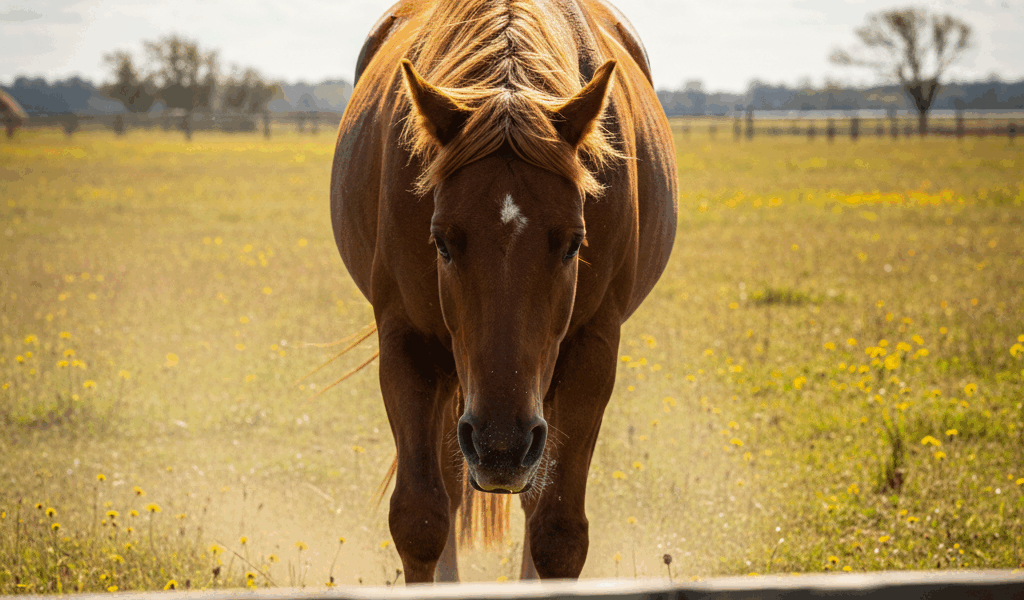
Why Your Horse Is Charging at You
Dealing with a charging horse has gotten complicated with all the conflicting advice flying around. Stand your ground. Move sideways. Use a flag. Don’t use a flag. Everyone has an opinion, and meanwhile you’re the one standing in a pasture with 1,200 pounds of horse moving at you with ears back.
So, without further ado, let’s dive in.
Most horse owners I’ve talked to after this happens are caught somewhere between angry, scared, and guilty. The guilt is the weird part. You keep wondering if you caused it somehow. You probably didn’t. But the answer to that question depends entirely on which of the three causes is actually driving your horse — and the fix changes completely depending on which one it is.
Resource Guarding
This is the most common trigger. But what is resource guarding, exactly? In essence, it’s your horse defending something it considers valuable — usually food. But it’s much more than that.
Watch what happens right before the charge. Is your horse near a hay pile, a grain bucket, the water trough? Does it happen mostly at feeding time? That’s resource guarding, pure and simple. Your horse isn’t coming after you personally. It’s using herd language. Horses pin ears and move other horses away from feed constantly — you’re just getting the same treatment a pasture mate would get.
Multi-horse situations make this dramatically worse. A horse low in the herd hierarchy becomes almost paranoid about resources because it doesn’t get first access to anything. I once worked with a Quarter Horse mare named Penny — sweet, uncomplicated horse when alone — who turned into a charging machine the second she was turned out with two others. The moment the hay net went down, anything that moved near it was a target. Horses, handlers, didn’t matter to her. That was 2018, and it took about six weeks to untangle.
Learned Behavior from Hand-Feeding or Retreating
Some horses charge because charging works. You handed out treats once. Then twice. Then it became a thing. One day the treats aren’t there, and your horse trots over anyway — pushing harder, crowding more, trying to produce them through sheer persistence.
That’s the hand-feeding trap. I’m apparently a slow learner on this one, and peppermints worked for me as a bonding tool while boundaries never got established. Don’t make my mistake. Hand-feeding isn’t evil, but it teaches a horse that moving aggressively toward humans produces rewards. The math is simple once you see it.
The retreat problem is honestly worse. If you’ve ever stepped back from a horse that crowded you — even politely, just to give it space — your horse learned something that day: move toward humans, humans move back. That becomes a game. The behavior escalates because your horse gets rewarded every single time you shift your weight backward.
Herd Hierarchy Confusion
Less common, but real. Some horses charge because they’re testing your position. This happens most with young horses, newly purchased horses, or situations where clear boundaries were never established. The horse isn’t necessarily angry — it’s checking. Can it move you? Are you serious? If your answer, through body language and reaction, is “yes, I’ll move,” the behavior deepens fast.
That’s what makes this particular cause endearing to us horse people in a strange way — the horse is just doing what horses do. It just happens to be doing it to a person instead of a pasture mate.
How to Tell If It Is Aggression or Just Pushy Behavior
Probably should have opened with this section, honestly. This distinction changes everything, and applying the wrong approach makes things measurably worse.
Real aggression includes:
- Ears pinned flat, pressed back toward the poll
- Teeth bared or snapping — sometimes a quick reach and grab
- A charge with full commitment — the horse doesn’t stop, doesn’t swerve, seems locked in
- Escalation over time instead of improvement
- Aggression that appears even when you’re nowhere near resources
Pushy behavior looks like:
- Ears forward or neutral, maybe drifting slightly back
- The horse trots or walks toward you expecting something — usually treats
- Crowding and bumping into your space, but without real menace behind it
- The charge deflects or stops if you move deliberately
- The behavior shows up specifically at feeding time or when you’re carrying something
If your horse is being pushy, you can address this yourself with consistency and time. True aggression needs a professional — immediately, not after another incident.
Step-by-Step How to Stop the Charging Behavior
Immediate Safety — In the Moment
Your instinct screams to run. Don’t. Running reinforces the behavior because your horse gets exactly what it wanted — you moved. The horse files that away and tries it again next time, harder.
Stand tall. Expand your body. Raise your arms slightly out from your sides. Face the horse directly — not sideways, not angled away. Use a firm voice. Not shouting, just authoritative. “Back” works better than “no” in my experience, because it gives the horse something specific to do.
While you won’t need elaborate equipment, you will need a handful of basic tools — a flag, a lunge whip, or even a stiff lead rope. Use it as a boundary extension. Swing it in front of the horse’s path, not at the horse itself. You’re creating a visual line. The moment your horse slows, hesitates, or stops, reward it immediately with a quiet, calm voice. Not treats right now. Just your tone dropping, your body softening. Horses read that clearly.
Change the Feeding Routine
Stop hand-feeding immediately. Everything goes in a bucket or feeder — grain, treats, all of it — placed away from where you’re standing. Drop it and step back. You stop being the treat dispenser and become something else entirely.
First, you should establish a boundary at the gate before you ever walk in with feed — at least if you want results that actually stick. Stand there and wait until your horse moves back. Even one step back. Then you walk in. This teaches a simple equation: back up, good things happen. Crowd forward, nothing happens. Repeat that equation 200 times and it becomes permanent.
Controlled Approach and Retreat
A round pen might be the best option, as this work requires your horse to have limited space to build momentum. That is because a large pasture gives a horse 50 yards to decide it’s committed to a charge before you can respond to the early signals.
Walk toward your horse slowly. The moment it shifts weight toward you, takes a step forward, even just locks eyes with interest — stop walking. Don’t advance. Wait. Then retreat a few steps yourself. Pause. Walk in again. What you’re teaching is that moving toward you ends the interaction, and moving away from you continues it. That sounds backward until it works, and then it seems obvious.
Body Language Corrections
Walk into that pasture with purpose. Don’t shuffle. Don’t hesitate at the gate. Hesitation reads as uncertainty — uncertainty reads as weakness. Your shoulders, your pace, your eye contact — all of it is broadcasting information to your horse constantly.
Square your shoulders when your horse approaches. Make brief eye contact rather than staring or looking away. Hold your ground. Pivoting sideways to release pressure is a useful tool eventually, but save it for later — use it too early and you’re just teaching your horse that charging makes you turn away.
What Not to Do When Your Horse Charges
- Don’t run away. You’re starting the chase game. Your horse wins that game every time, and the prize is a better understanding of exactly how to move you.
- Don’t throw feed as a distraction. You just gave the horse exactly what it was pushing for. That behavior is now locked in permanently.
- Don’t punish after the fact. Horses don’t connect punishment to behavior if more than a few seconds have passed. You’ll create fear and confusion and the charging will continue, now with anxiety layered on top.
- Don’t write it off as personality. A charging horse gets bolder over time, not calmer. Every time it works, the behavior calcifies a little more.
- Don’t hand-feed treats while trying to fix this. You’re working directly against yourself and adding weeks to the process.
When to Call a Professional Trainer
Frustrated by two or three weeks of consistent effort with no improvement — or if your horse has already made contact with you or anyone else — bring in a trainer who specifically handles behavioral cases. Not a riding instructor. Someone who assesses aggression and has a documented process for it.
Stallions charging should go to a professional almost immediately. The risk calculus is different. Mares and geldings showing true aggression — bared teeth, escalating charges, behavior that appears away from resources — also need professional eyes on them before someone gets seriously hurt.
Ask any trainer you consider how they assess aggression before they start working with the horse. Avoid anyone who promises a 30-day fix or relies entirely on punishment. This new approach of behavioral assessment combined with consistent groundwork has evolved into the standard that experienced trainers use and trust today — for good reason.

Leave a Reply