When Your Horse Keeps Bucking Under Saddle—Here’s the Real Fix
Bucking under saddle has gotten complicated with all the conflicting advice flying around. Everyone online has an opinion—”ride through it,” “sell the horse,” “it’s all natural horsemanship.”
Most people skip the actual diagnosis and jump straight to “bad horse” or “bad training.” That’s the wrong move. The difference between a horse bucking because it’s in pain and a horse bucking because you’re gripping with your leg is everything. One requires a vet. The other requires you to fix your seat. So, without further ado, let’s dive in.
First Ask Yourself When and Where the Bucking Happens
Pattern recognition is your fastest diagnostic tool. Not all bucking is created equal — at least if you’re paying attention to when and where it happens, the pattern practically tells you the answer.
Bucking at canter departure specifically
This one’s a classic pain signal. But what is canter departure bucking, really? In essence, it’s your horse objecting the moment energy demands increase. But it’s much more than that — it usually points to ulcers, SI joint soreness, or stifle discomfort specifically. The canter demands more abdominal engagement and hind-end power than the trot. A horse with gut pain feels that transition acutely. My mare had a combination of ulcers and SI joint inflammation. Not a behavior problem at all. That was 2019.
Bucking going downhill
Downhill work puts enormous pressure on the hind legs and back. A horse that bucks on slopes but is perfectly fine on flat ground — that’s almost always saddle fit issues, back soreness, or hind-end pain. The angle forces different hind-end engagement. Something hurts back there, they’ll let you know. Stubbornness almost never explains downhill bucking specifically.
Random bucking throughout the ride
Scattered, unpredictable bucking — different gaits, different arena locations, no real pattern — often points to rider balance or leg grip. The horse isn’t anticipating where the next squeeze will come from. Reactive, not premeditated. That said, don’t rule out pain yet. Some horses with chronic soreness buck inconsistently because certain moments are worse than others. I learned this the hard way.
Bucking only with one specific rider
This is the biggest tell you’re looking at a rider problem. A horse doesn’t suddenly develop pain when a certain person mounts. But a horse absolutely learns that one rider sits heavily, squeezes constantly, or pulls back without warning. If your horse is an angel for your trainer but a bronc for you, the issue lives in the saddle — not under it. That’s what makes this pattern so revealing to us riders who would rather blame the horse.
Rule Out Pain Before You Do Anything Else
Probably should have opened with this section, honestly. The diagnostic flow matters because it saves you from wasting months on training fixes when your horse actually needs a vet.
Check saddle fit first
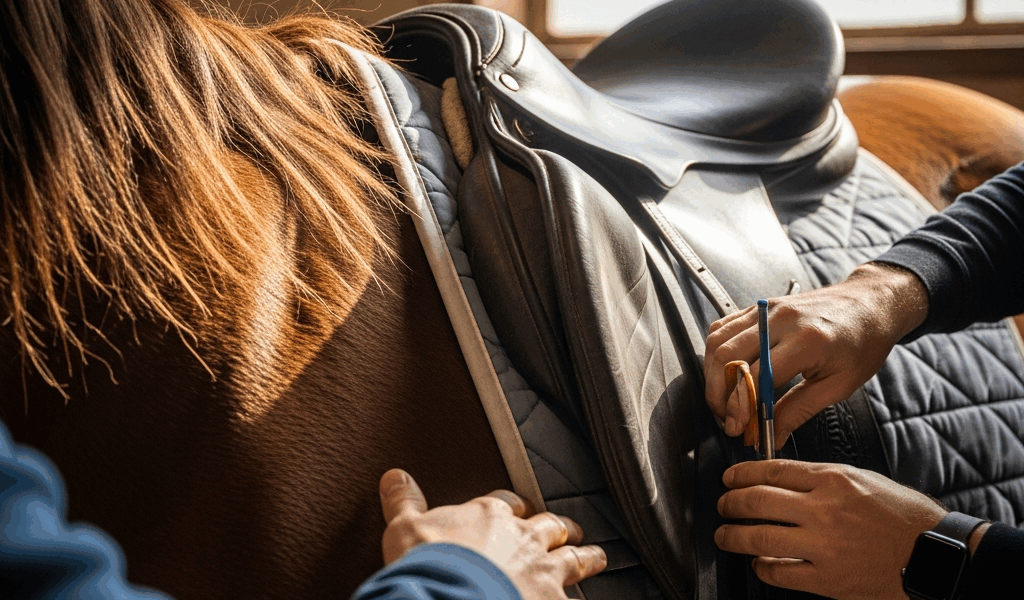
A poorly fitting saddle is the fastest path to a bucking horse. You’re looking at three things: tree width, balance, and clearance.
Tree width means the saddle’s widest point sits just behind your horse’s shoulders without pinching. Too narrow, it digs into the withers. Too wide, it rolls side to side. Run your hand under the saddle after 15 minutes of actual riding — not just standing there. Even pressure along the entire panel, or pressure points? You’ll feel the difference.
Balance means the saddle shouldn’t tip you forward or back before your horse even moves. A broken tree or worn panels pitches you out of center. Sit on a mounting block. Have someone look at you from the side. Tilted forward already? The saddle is the problem.
Clearance is about your horse’s spine. Two fingers under the gullet when the saddle is on — that’s your minimum. Less than that, you’re loading pressure directly onto the spine. More than four fingers, the saddle is too wide.
If your saddle doesn’t pass this test, borrow a properly fitting one and take a short 20-minute ride. Does the bucking decrease? You’ve found your answer. I’m apparently someone with narrow-withered horses, and my Pessoa A/O works for me while my old Wintec 500 never did. Found the Pessoa on Facebook Marketplace for $600. That’s cheaper than three vet visits. Don’t make my mistake of riding in the wrong saddle for eight months before checking.
Check for back soreness with the pressure test
You don’t need a vet to spot this one — at least not yet. Run your thumb along both sides of your horse’s spine, pressing firmly from behind the saddle area back toward the hindquarters. A horse with back soreness flinches, hollows away, or drops the hip when you hit something sore. Some grunt. That’s your signal to call the vet.
Watch for the ulcer and SI joint flags
A horse bucking at canter departure, seeming girthy, reluctant to stretch forward, losing condition despite good feed — that’s your ulcer checklist. Equine gastric ulcer syndrome is absurdly common. One study found it in 60% of performance horses. The horse isn’t being difficult. It’s in pain. A vet confirms with a gastroscope, which runs around $300 to $500 depending on your area. Treatment is omeprazole — generics work fine and most cost $40 to $100 per month.
SI joint soreness shows up differently: reluctance to engage the hind end, bucking on leads, stiffness that’s worse after work, shortened stride behind. Your vet can assess this, but treatment usually starts with rest, anti-inflammatories, and possibly SI joint injections — around $500 per side. Not cheap, but cheaper than the alternative.
Get a vet exam if bucking is consistent
If the bucking happens regularly and the pressure test revealed sensitivity, call your vet. Bring a video of the bucking — the specific moment it happens, not just general footage. Most equine vets charge $150 to $300 for a lameness exam. Yes, it’s an investment. A $400 vet visit beats buying a new horse because this one has become genuinely dangerous.
Check Your Riding Before You Blame the Horse
Once pain is reasonably ruled out — saddle fits well, back isn’t sore, vet gave the all-clear — look in the mirror. Uncomfortable as that is.
Gripping with your lower leg creates tension, especially at transitions. A horse reads a leg squeeze as “more energy.” If you’re simultaneously holding the reins, the horse gets two conflicting instructions: go forward and don’t. Short answer? Bucking.
Sudden hand contact is another one. Loose in the saddle, then grabbing the reins for balance — especially common when posting — your horse feels a jab in the mouth right as you’re asking for more power. Bucking fixes this, from the horse’s perspective.
Unbalanced seat is the third culprit. Tipped forward or sitting behind the motion, your weight isn’t giving clear signals. A horse that only bucks with you but not with your trainer? Your trainer probably has a more secure, centered seat. That’s what makes this so frustrating — it’s invisible to the person doing it.
Here’s what to actually do: Get a ground person to lunge you in a round pen or small arena. Seriously. Or hire a trainer for a video lesson — usually $50 to $150 — where they film you riding so you can see what you’re actually doing versus what you think you’re doing. Most riding problems are completely invisible to the rider experiencing them.
How to Correct Behavioral Bucking Step by Step
If pain is ruled out and your seat is reasonably solid, now you can address the behavior itself.
- Use the go-forward correction. The moment you feel the horse starting to buck, drive forward with your lower leg underneath you — not gripping, just underneath. More forward motion makes bucking mechanically harder. A horse actively trotting forward stops bucking. This teaches the horse that forward motion works and bucking doesn’t.
- Apply a firm inside bend. If the go-forward cue isn’t stopping the buck, bend the horse sharply to the inside — like asking for a tight circle. This interrupts the bucking cycle by forcing sideways hind-end engagement instead of straight back. You genuinely cannot buck properly in a correct inside bend.
- Build confidence with gymnastic work. Poles, gait transitions, cavaletti — these train balance and focus simultaneously. A horse engaged in purposeful work doesn’t have bandwidth left over for bucking. Spend two to three weeks on this before asking for the transitions that previously triggered the problem.
- Never jab the reins. Yanking back when the horse bucks makes it worse — almost every time. Use rein contact only if you need to slow an out-of-control horse. Otherwise, steady hands.
- Stay consistent. One ride of correction isn’t enough. You need five to seven rides of the same response to the same behavior before the horse truly understands what you’re asking. Most riders quit after two rides and assume the approach failed.
When Bucking Is Dangerous and You Need Outside Help
Some situations are beyond a DIY fix. Know your limits — at least if you want to stay safe.
Frustrated by escalating bucking that’s already unseated you once, many riders keep trying to ride through it alone. Don’t make that mistake. A young horse that’s never been reliably started, a horse whose bucking is getting worse, or any horse that’s caused a fall needs a professional restart. That’s not failure — it’s safety. A trainer experienced with problem horses typically runs $1,500 to $3,000 for a 30-day program. That’s cheaper than emergency care.
Some horses have neurological issues — EPM, stringhalt, other conditions — that mimic behavioral bucking but require specific veterinary treatment. If your vet suspects this, imaging or a spinal tap may be necessary. This new level of diagnosis took off in equine practice several years ago and eventually evolved into the comprehensive lameness workups enthusiasts know and rely on today.
Most bucking is fixable once you find the root cause. Pain resolves with treatment. Bad riding improves with awareness and practice. Bad behavior responds to consistency. Figure out which one you have — and you’ve already solved half the problem.

Leave a Reply