Why Horses Pull on the Reins in the First Place
Rein pulling has gotten complicated with all the conflicting advice flying around. For a focused mouth, dentistry, bridle, and bit assessment, use our horse-fussing-with-the-bit checklist.
There are three distinct reasons a horse keeps pulling. Figuring out which one applies to yours is the difference between solving it in a week and fighting it for months.
The first bucket is physical discomfort. Your horse isn’t being stubborn — something hurts. Mouth pain from a poorly fitted bit, sharp molars, ulcers, back soreness. These things change how a horse carries itself entirely. They brace against the reins because bracing relieves pressure on a sore spot. I made this mistake early on, spending six weeks doing transitions on a horse with undiagnosed ulcers. The reins never got softer. The problem lived in his stomach, not his training. Don’t make my mistake.
The second reason is learned evasion. If a horse was yanked on repeatedly, lunged hard with side reins cranked tight, or forced into a frame before developing the strength to hold it — he learns that pulling and bracing protect him. He’s not pulling because he wants to. It’s the defense mechanism that worked before, so he keeps using it.
The third cause sits in the saddle with you. Tight hands. A shifting, unbalanced seat. Nagging contact that never fully releases. Horses are mirrors — if you’re holding tension, your horse holds it right back. Most riders miss this one entirely, because it requires looking at your own position first. That’s uncomfortable. Most people skip it.
Check These Things Before You Blame the Horse
Probably should have opened with this section, honestly. Skip the training work until you’ve ruled out pain.
Bit Fit and Type
But what is proper bit fit? In essence, it’s a snug placement without pinching. But it’s much more than that. A typical snaffle should sit about a quarter-inch from the corner of the mouth on each side — not pressing against the teeth, not gaping. Horses with narrower faces often do better in a 4.75-inch bit than the standard 5-inch. I’m apparently a narrow-horse person, and the smaller size works for me while the standard width never did on two of my own horses.
I’ve seen horses pull for months and then improve dramatically just by switching from a loose, clanging French link to a properly fitted eggbutt. That was a $45 bit swap. Six months of struggle, solved in a week.
Some horses genuinely prefer different mouthpiece styles too. A thick, smooth mouthpiece distributes pressure differently than a thin one. A double-jointed snaffle spreads pressure more evenly than a single joint that can create a nutcracker effect against the roof of the mouth. Worth considering if your horse pulls aggressively.
Dental Floating
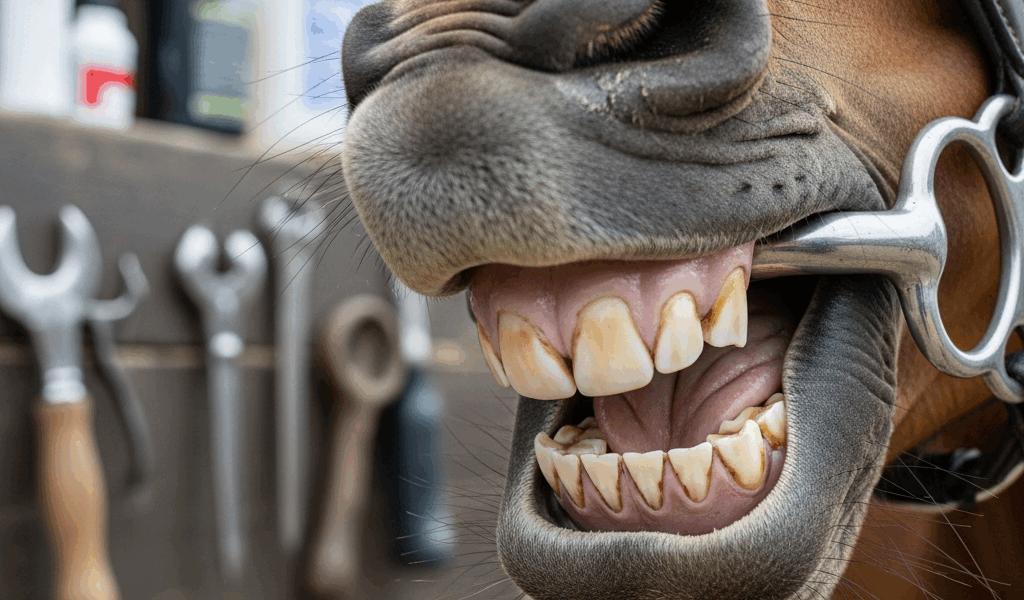
When was the last time your horse had his teeth floated? The answer should be within the last 12 months. Sharp molar edges force a horse to shift his jaw sideways to chew, which changes how he accepts the bit entirely. Have your vet or equine dentist check specifically for sharp edges on the bars — that’s the space between front and back teeth where the bit actually sits. People forget about the bars. Don’t.
Back Soreness and Saddle Fit
A horse with back pain will pull on the forehand and brace against contact. A saddle that bridges — meaning it doesn’t make contact along the entire tree — or sits too far forward, or has panels that don’t match your horse’s back shape, forces the horse to hollow and grab the reins for balance. He’s not being difficult. He’s holding himself together.
Run your hand under the saddle after 10 minutes of riding. Both sides should feel warm and even. Cold spots mean no contact. Hot spots are pressure points. A saddle fitter will catch problems you genuinely cannot see yourself. Full evaluations run $150 to $300 — and that’s the best money you’ll spend if tack is the culprit.
Ulcers
Horses in heavy training, kept in stalls, or under stress develop gastric ulcers regularly. A horse with ulcers often turns sour, pulls on the reins, loses weight, develops a dull coat. You can’t see ulcers without a gastroscope — your vet will need to scope the stomach if you suspect them. Medication runs about $200 to $400, depending on the protocol. In many cases it solves the pulling almost overnight. That’s how fast the change can happen when the actual problem gets addressed.
Step-by-Step Fix for a Horse That Pulls on the Forehand
Once you’ve ruled out pain, your job becomes teaching the horse that softness is rewarded and pulling is not. So, without further ado, let’s dive in.
- Establish a soft following hand first. Before asking for anything else, your hands need to follow the motion of the horse’s mouth completely. If your horse pulls, your hands don’t fight back — they move with him in a straight line. This takes the reward out of pulling, because pulling no longer creates the pressure-release-relief cycle he’s learned to expect. Spend entire rides just following. Nothing else. It feels passive. It isn’t.
- Use walk-halt and halt-walk transitions as your primary tool. Transitions demand balance and engagement without speed. Ask for the halt with your seat and legs — not your hands. The moment his feet stop, release all hand contact. That release is the reward. Five or six transitions per ride. They’re worth more than 20 minutes of flatwork, because they teach the horse to respect leg and seat rather than leaning on the bit for support.
- Introduce leg before hand every single time. If your horse speeds up or leans, your calf asks him to lighten his front end and step underneath himself. Only after the leg does its job do your hands soften. A horse that learns to respect leg contact stops seeing your hands as something to brace against. That’s the whole shift.
- Add lateral work — serpentines, small circles, shoulder-in on the rail. When a horse bends around your inside leg, he physically cannot brace against the bit at the same time. His ribcage and spine are busy doing other things. Start with 20-meter circles at a walk. As he softens, decrease the size gradually. Bending breaks the bracing pattern in a way that straight-line riding simply never will.
Common Mistakes That Make the Pulling Worse
- Pulling back when the horse pulls. This is the tug-of-war trap. Your horse pulls, you pull harder, he pulls harder. He weighs 1,000 pounds — minimum. You will not win this. Release the instant your horse softens even slightly. Ignore the pulls entirely. The release does all the teaching.
- Dropping contact at the wrong moment. Loose reins are great rewards — but only when offered as a release after softness. Drop contact while your horse is actively pulling, and you’ve just taught him that pulling earns freedom. Keep a light following contact always, then release fully when he halts or gives through the poll.
- Working only in straight lines. Pulling is easy in a straight line. Bending breaks the pattern. If your horse pulls consistently, 80% of your ride should happen in curves, circles, and lateral movements. Straight lines are where bracing lives.
How Long Until the Pulling Stops
Mild cases — horses that started pulling recently — often show real improvement within 3 to 5 days of consistent transitions and lateral work. You’ll notice your horse starting to seek a softer contact rather than leaning into it. That’s what makes the process endearing to us riders. The horse starts meeting you halfway.
Deeply ingrained habits take longer. Months or years of pulling means planning on 3 to 4 weeks of daily rides before the behavior fades significantly. Expect plateaus — four or five days where nothing changes, then sudden improvement. That’s normal. Don’t panic during the flat stretches.
Progress tends to look like this: Week one, pulling softens slightly during transitions only. Week two, he seeks softness at walk and trot. Week three, he holds softness over longer stretches without being asked. Week four, the pulling becomes occasional rather than constant.
For your next ride, do this one thing: 10 minutes of walk transitions with a purely following hand. No other agenda. See what your horse tells you.

Leave a Reply