Why Horses Trip More on Trails Than in the Arena
Trail riding with horses has gotten complicated with all the conflicting advice flying around. Slow down. Speed up. Get new shoes. Call the vet. Everyone has an opinion, and most of it skips the actual diagnosis.
Here’s what I know from years of riding the same horses in both arenas and backcountry terrain: the arena hides things. Flat, groomed footing is forgiving. Trails are not. Uneven ground demands constant micro-adjustments — tiny corrections your horse makes dozens of times per minute — and when something isn’t working right, that’s when the stumbling starts.
Tripping isn’t the problem. It’s a symptom. A horse with weak hindquarters or iffy hoof balance can cruise around a groomed ring all day. Put that same horse on a rocky descent at mile four, tired and distracted, and suddenly his feet aren’t landing where he thinks they are. The fix depends entirely on which symptom you’re dealing with. Generic “just slow down” advice won’t touch a farrier problem. And no amount of conditioning fixes vision loss. So, without further ado, let’s dive in.
Check These Four Things Before Anything Else
Before calling the vet or blaming your riding, look for these four root causes. Most tripping horses fall cleanly into one category — and once you identify it, the fix becomes obvious.
Hoof Balance and Breakover Angle
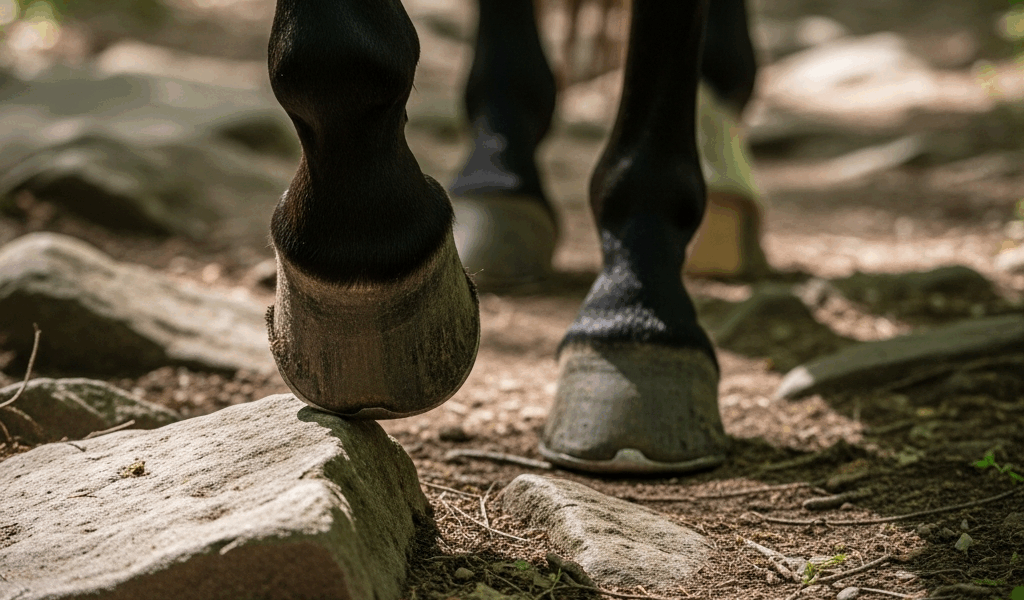
Pick up your horse’s front hooves. Run your hand along the bottom. Long toes? Low heels? The toe-to-heel angle should look like a natural slope, not a ski ramp. A farrier mistake here — or just six weeks of growth between trims — creates what’s called delayed breakover. The toe catches on uneven ground because it’s not rolling over naturally.
How to spot it: tripping happens consistently at the walk or trot, doesn’t get worse as the ride goes on, shows up mostly on the front end. That pattern almost always points back to the feet.
Vision Problems
Older horses especially develop cataracts or general age-related vision loss. They genuinely cannot see the trail well enough to place their feet accurately. A horse squinting in bright sun, hesitating at shadowed sections of trail, or carrying his head at an odd angle might be compensating for something he can’t tell you about.
How to spot it: tripping gets worse in low light or dappled shade, the horse seems genuinely uncertain about foot placement rather than lazy, and — this one’s telling — he might trip on the same rock or root twice.
Low-Grade Lameness
The arena hides this one particularly well. Mild hock soreness or subtle front-limb discomfort is manageable on flat, predictable footing. Variable terrain with real load? The horse favors the sore limb, can’t weight it normally, and trips.
How to spot it: tripping gets worse as the ride progresses, appears more pronounced on one side, and the horse may seem stiff and reluctant when you first mount up.
Poor Fitness or Weak Hindquarters
Trails demand real engagement — not just forward movement, but active pushing from behind. Unfit horses can’t hold themselves together on variable terrain. The hindquarters disengage, the front end gets clumsy, and down goes the toe.
How to spot it: sporadic stumbling early on that becomes dramatically worse by mile three or four. The encouraging version of this problem — the horse improves noticeably after a week or two of consistent conditioning work.
Hoof and Shoeing Fixes That Make an Immediate Difference
Probably should have opened with this section, honestly. Long toes are the most common culprit I see, and one good trim by a competent farrier resolves the majority of trail-tripping cases before anything else needs to happen.
A hoof with a too-long toe and low heels delays breakover. Think about walking in shoes where your heel is compressed and your toe drags the floor with every step — that’s your horse’s experience. He can’t roll over the toe cleanly. On variable terrain, that slight mechanical delay translates directly into catching and stumbling.
What to actually look for: the distance from the back of the heel to the widest part of the toe, measured at the bottom of the hoof, should run roughly 50–55% of the total hoof length. If your farrier has been leaving toes long “for protection” or “natural movement,” ask specifically about shortening the breakover while keeping heel height intact.
Call your farrier and say exactly this: “Can you shorten my horse’s breakover by rolling or rockering the toe?” Don’t just say “my horse is tripping.” Farriers respond to specific shoeing requests far better than vague complaints. If they push back or dismiss it, get a second opinion — a good farrier working with trail horses understands breakover optimization.
Barefoot versus shod is honestly a personal choice that doesn’t move the needle here. What matters is hoof angle and breakover, full stop. Barefoot horses need the same balance. Shod horses need a shoe shaped to roll the toe. I’m apparently a “both-are-fine” person, and that approach works for me while the barefoot-vs-shoes debate never actually solved a single tripping problem I’ve seen.
Budget $150–$250 for a corrective trim or reset depending on your region and whether your horse is barefoot or shod. Don’t make my mistake — I spent three months trying riding adjustments before finally calling the farrier, and the problem cleared up in two weeks after a proper trim.
Riding Adjustments That Reduce Tripping Right Now
Even with perfect hooves, a horse trailing behind your leg with no impulsion will trip. Impulsion prevents tripping. Collection prevents tripping. Simply slowing down does not.
Ride forward — not faster. Forward. There’s a real difference. A horse moving with engagement, hindquarters underneath him, genuine momentum in his stride, places his feet deliberately. A horse poking along on a loose rein, disconnected from your leg, stumbles. That distinction matters more on trails than anywhere else.
Use half-halts before terrain changes. Approaching rocky ground or a steep section? Half-halt — brief pressure with your core and seat, not a rein yank — to rebalance and alert him. That shift of weight back onto the hindquarters sharpens attention noticeably. It’s a small thing that makes an outsized difference.
Keep his mind on the job. Distraction kills focus — that’s what makes trail riding genuinely different from arena work. If your horse is rubbernecking at birds or spooking at shadows instead of watching the footing, he trips. Maintain contact. Use your inside leg to keep the shoulder in line. Make him think about what he’s doing.
Here’s the most common mistake I see: riders with a tripping horse slow everything down and go loose, thinking it’ll help. It doesn’t. Slowness without engagement makes tripping worse — sometimes dramatically so. Your horse needs impulsion and collection, not a casual amble on a draped rein through technical terrain.
When Tripping Means a Vet Call — Do Not Ignore These Signs
Some tripping is neurological. Equine Protozoal Myeloencephalitis — EPM — and Wobbler Syndrome both present as progressive incoordination and stumbling that worsens over weeks, not days. These aren’t farrier problems. They require diagnosis and treatment.
Call your vet this week if: the tripping is getting worse after two weeks of corrected hoof work and intentional riding. If it’s asymmetrical — one hind leg crossing over or clipping the other. If your horse is stumbling at a standstill, which is never normal. If you’re seeing dragging hooves, general weakness, or loss of coordination across all four limbs simultaneously.
But what is the realistic picture here? In essence, it’s this — most tripping horses are fixable, and the fix isn’t complicated. A farrier appointment and two weeks of conditioning work clear up the majority of cases. You don’t need to panic. You need to diagnose methodically, rule out the simple causes first, then escalate if the pattern keeps pointing somewhere more serious.

Leave a Reply