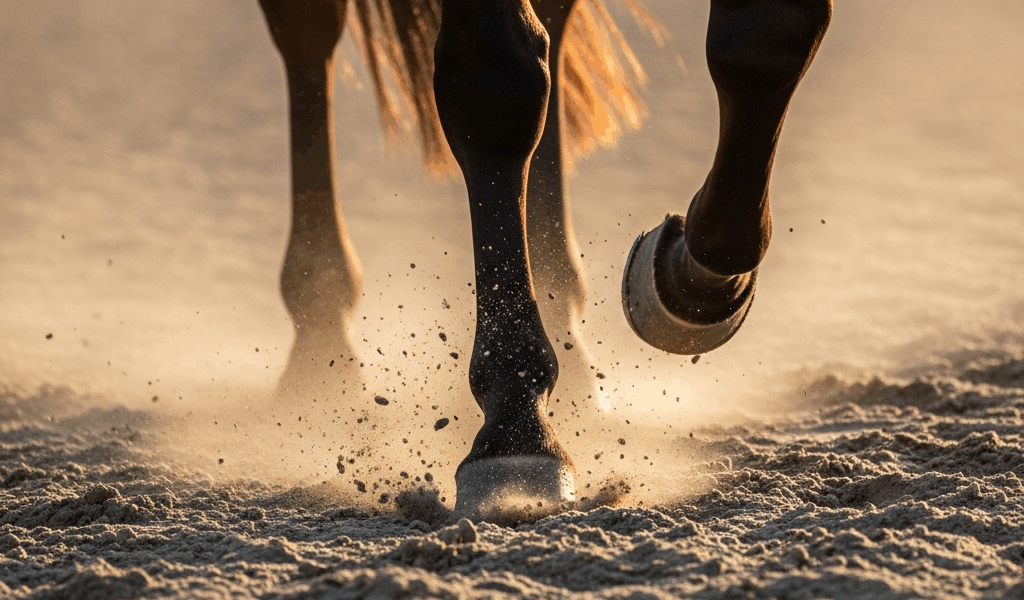
Why Arena Stumbling Is Different From Trail Tripping
Arena stumbling has gotten complicated with all the conflicting advice flying around. Your horse keeps going down in front during circles, or randomly through transitions, and everyone online has a different theory. But here’s the thing that matters — he’s completely fine on the trail. That single detail tells you more than most articles will admit.
Think about what arena work actually is. Repetitive. Controlled. Same footing, same demands, same rider position every single time. You’re asking for collection instead of forward momentum. Trail riding is the opposite of all that. So when a horse stumbles specifically in the arena, you’re dealing with muscle fatigue, breakover mechanics, or a balance problem you’re creating from the saddle. Not roots. Not rocks. Not laziness. That distinction changes everything about where you start looking.
The Four Most Common Causes to Check First
Footing Depth and Consistency
Probably should have opened with this section, honestly. Arena footing is the fastest culprit and the easiest to either confirm or cross off the list. A horse stumbles when his foot sinks deeper than he expected — or when the ground shifts density mid-stride and he can’t compensate fast enough.
Walk your arena barefoot or in thin-soled boots. Actually feel it. Most stumbling clusters in the corners and along the rail, where traffic is heaviest and footing compacts unevenly. Walk the center and you’ll feel the difference immediately. If you’ve got 4 inches of depth in some spots and barely 2 in others, your horse is constantly recalibrating his stride to account for it. That recalibration? That’s what a stumble looks like from the saddle.
Diagnostic sign: Stumbling happens in the same location every ride, or gets noticeably worse as the arena gets used throughout a lesson day.
Hoof Length and Breakover Angle
A long toe delays breakover. The foot stays on the ground longer than the body is ready for, weight shifts forward faster than the front limb can catch up, and the toe clips the dirt on the next stride. That’s the stumble, right there.
I learned this the hard way riding a Warmblood mare for a trainer outside Lexington, Kentucky. She stumbled constantly — specifically at sitting trot, not other gaits, which should have been my first clue. A farrier finally pointed out her toe was a full inch longer than it should have been. Her front shoes were worn through at the toe, shifting her breakover point by nearly 2 inches. We re-shod her. Stumbling stopped within one ride.
Diagnostic sign: Stumbling shows up at specific gaits — usually trot — and the toe of her front hoof or shoe looks blunt, worn flat, and rounded at the very tip.
Early-Stage Hind-End Weakness or Muscle Fatigue
A horse that can’t push properly from behind gets strung out in front. His front legs pick up the slack his hind legs aren’t handling. Front-end fatigue follows. Stumbles follow that.
This builds over weeks, not overnight. It worsens as the workout runs longer. Ride him 45 minutes — sound through the first 20, tripping through the last 15 — and his hind end is telling you something. Don’t make my mistake of blaming the footing for three weeks before I actually looked at the horse.
Diagnostic sign: Stumbling gets progressively worse within a single session, or appears more frequently the day after hard work — sometimes two days after.
Rider Balance Interfering With His Front End
Tip forward. Collapse at the hip. Your weight lands on his forehand instead of staying centered over his back, and now he’s managing your balance on top of his own locomotion. Circles make this worse — you’re already asking him to shift his weight laterally, and you’re adding instability on top of that request.
This is the hardest one to self-diagnose. You need eyes on you, either a trainer watching a lunge session or a video taken from behind and from the side. You won’t see it yourself. I’m apparently a chronic hip-collapser and my Pessoa saddle helps me stay honest while my old County never fixed the problem.
Diagnostic sign: Stumbling happens primarily on circles and drops off noticeably when a trainer gives you one specific correction — deeper seat, shoulders back, quieter hands.
How to Test Whether It Is a Shoeing or Hoof Problem
Before you text your farrier, spend two minutes doing a visual check yourself. Pick out both front feet. Look at the toe length relative to the pastern angle — it should run roughly 45 to 50 degrees, matching each other cleanly. A toe that looks noticeably longer, or one that’s gone blunt and squared off instead of holding its shape, is interfering with breakover.
Then check the shoes. Look at the toe of each front shoe. Worn flat and shiny, or a visible groove worn into the metal — his foot is dragging at breakover on every single stride. That dragging is the stumble you’re feeling.
When you call your farrier, don’t just say “he’s stumbling.” Say this instead: “His stumbles happen at trot on circles, his toe looks longer than his pastern angle, and I think it’s a breakover issue.” That sentence tells your farrier exactly what they’re walking in to look at. A good one will measure toe length, assess breakover timing, and either reset the shoe or adjust the angle — or both, depending on what they find.
Expect $120 to $180 for a reset depending on your region. Worth every dollar to either fix the mechanical cause in one visit or rule it out completely.
Arena Exercises That Reduce Stumbling Over Time
Once footing and shoeing are off the table, start rebuilding. These aren’t training parlor tricks — they’re specific movements that develop the strength and body awareness he needs to stop catching himself on his own feet.
Transitions between gaits. Walk to trot, trot to canter, canter back down — lots of them, both directions. Transitions demand hind-end engagement and force him to lift his feet higher out of habit. Higher pickups mean fewer toe-catches. Four or five transitions per direction, several times a week, is the baseline.
Poles on the ground in a line. Space four poles roughly 4 feet 6 inches apart — adjust slightly for his natural stride. Trot through them. Poles demand precision. His brain engages with his feet instead of drifting on autopilot, and stumbles are an autopilot problem, not a focused-attention problem.
Lateral work — leg-yield at walk and trot. Even three or four strides of leg-yield across the arena, repeated a few times, shifts load to the hind legs. Stronger hind legs stop front-end stumbles faster than almost anything else. Two weeks of this, twice a week, and you’ll see a visible difference.
Do all of this before you ask for collected work. Prepare the body first.
When Stumbling Means a Vet Call Not a Training Fix
Sudden stumbling in a horse that was previously sound. Stumbling that worsens day over day. Stumbling paired with ataxia — that wobbly, disconnected hind-end movement that looks like the back half of the horse doesn’t know what the front half is doing. Stumbling that shows up at walk, not just trot. Call your vet this week, not next.
EPM — equine protozoal myeloencephalitis — causes stumbling alongside genuine incoordination. Hind limbs look drunk. If you’re seeing that, call same-day if you can get through. Neurological conditions move fast without treatment.
Most arena stumbling is footing, shoes, or fitness — and most of it is fixable without a vet visit. But sudden onset, progressive worsening, or anything that looks neurological is a different situation entirely.
Your next step: Stumbling in one specific arena location — fix footing first. Stumbling at a specific gait with worn shoe toes — call your farrier and use the language above. Stumbling that worsens through the ride or appeared after a layoff — run the exercises for two weeks before deciding anything else. Sudden onset, incoordination, or stumbling that keeps getting worse despite everything you’ve tried — call your vet.

Leave a Reply