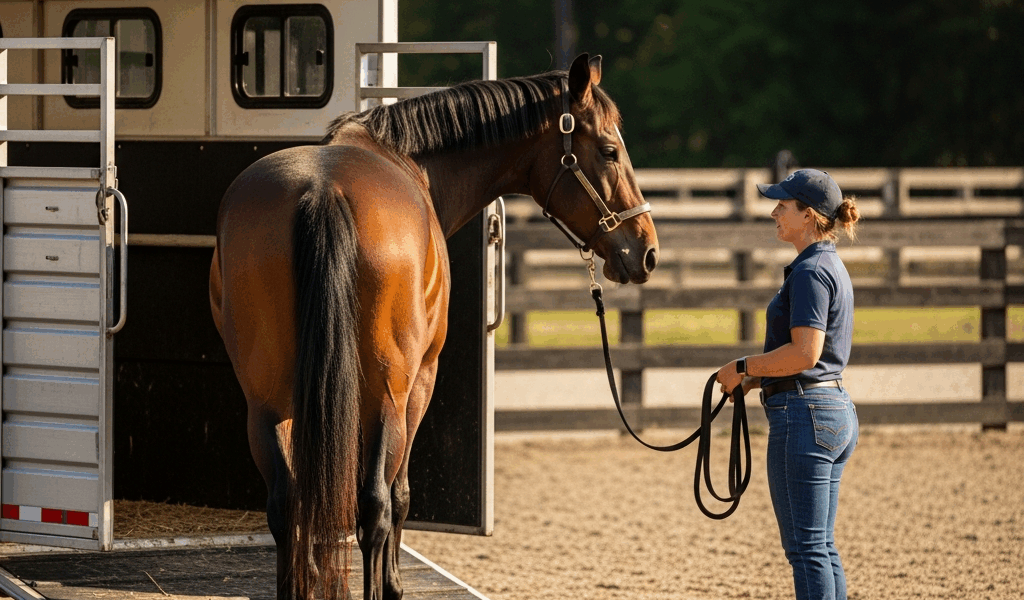
Why Horses Refuse to Load in the First Place
Trailer loading has gotten complicated with all the conflicting advice flying around. But after years of working with problem loaders — including one mare who took three dedicated weeks before she’d even approach the ramp calmly — I learned everything there is to know about what’s actually going on in a horse’s head at that threshold. Today, I will share it all with you.
But what is a loading refusal, really? In essence, it’s a horse making a rational decision based on its own risk assessment. But it’s much more than that. There are three distinct reasons a horse plants its feet, and figuring out which one applies to your specific animal changes everything about how you fix it.
The first is raw fear of enclosed spaces. Horses are prey animals — a dark, moving box with walls closing in triggers their flight instinct hard. Some horses have genuinely never felt safe in any confined space and will panic at the threshold before a single hoof touches the ramp.
The second is past trauma. Maybe the horse was rushed into a trailer once and cracked its head on the roof. Maybe it got cast during transport and spent two hours in a panic. Once a horse connects the trailer with real pain or terror, you’re fighting a stored memory, not just a basic instinct. That’s a different problem entirely.
The third is distrust of the footing. A slippery metal ramp or an unstable floor feels genuinely dangerous underfoot. The horse isn’t being stubborn — it’s doing the math and deciding the surface isn’t trustworthy enough to commit to. That’s what makes horses so endearing to us as handlers, honestly. They’re not dramatic. They’re just honest.
So, without further ado, let’s dive in.
What to Check Before You Try Again
Probably should have opened with this section, honestly. Before you touch a lead rope, do a full diagnostic walk-around. I learned this after spending 45 minutes fighting a gelding who was actually just spooked by the trailer door banging in the wind. The whole session was pointless. Don’t make my mistake.
Interior lighting. Open every door and window you’ve got. Can you see clearly all the way to the front wall? If you’re squinting, your horse is essentially looking into a cave. Dark trailers are scarier trailers — full stop. Clip a small LED work light inside if needed. A $14 magnetic shop light from any hardware store does the job fine.
Ramp condition. Walk it yourself first. Is it slippery? Wet? Are there loose pebbles shifting under your boots? If you wouldn’t trust it at speed, neither will a 1,200-pound animal. I use 3/4-inch stall mats cut to fit — usually around $80–120 for a pair, depending on your supplier. Some people swear by non-slip tape, but mats are faster to install and hold up through seasons of use.
Floor texture inside. Bare metal transmits every vibration and feels genuinely unstable. Shavings help. A rubber mat helps more. Even a tarp thrown over exposed metal can get you through in a pinch — not ideal, but functional when you’re working with what you have.
Herd separation anxiety. Is the buddy horse standing in a visible paddock while you’re trying to load? Your horse is mentally split between two places at once. Move the buddy out of sight entirely, or load them first if your rig has two compartments. This single fix resolves about a third of the loading problems I’ve ever seen.
Recent pressure or stress. Did you chase this horse twenty minutes ago? Twitch it? Get into a physical struggle? Adrenaline doesn’t disappear on command. Walk away. Come back in an hour. Layering failed attempts on top of each other is how you turn a nervous horse into a confirmed problem loader.
Step-by-Step Loading Method That Actually Works
Frustrated by weeks of contradictory trainer advice, I tested a straightforward pressure-and-release approach using a 12-foot lead, a well-fitted halter, and nothing else on three different horses — a 4-year-old Quarter Horse cross, a 12-year-old Thoroughbred, and a notoriously difficult Arabian mare. All three loaded within 10–30 minutes. Here’s exactly what worked.
Setup. Park on level ground. Doors open, ramp down, interior prepped — no shadows, matted footing, buddy horse dealt with. Clip a 12-foot lead to a properly fitted halter. Wear gloves and real boots. Leave your phone in the truck. This requires your full attention and nothing else.
Position yourself correctly. Stand on the horse’s left side, roughly two feet behind the shoulder, lead rope held loosely with about three feet of slack. You are not pulling. You’re positioning your body to suggest forward movement — that’s the entire job.
Apply light pressure. Walk toward the trailer. If the horse follows, keep walking. If it stalls, stop. Don’t pull harder — that reflex is the enemy here. Instead, turn away, walk a small circle (roughly 15 feet across), and approach from the same angle again. Repeat until the horse offers even one step toward the ramp. One step counts. Reward it like it counts.
Reward immediately. The second a front hoof touches the ramp, stop everything. Let the horse stand. Give a long, firm scratch on the neck or shoulder — I’m apparently very particular about this, and tactile praise works for me while verbal praise never really lands with horses the way people think it does. Wait ten seconds. Then ask again.
One foot at a time. Don’t expect a straight walk-in. Three days ago I spent 22 minutes on a mare who loaded one front foot, backed out, then placed one back foot, then finally committed with both front feet together. That is normal. That is progress. Treat it like progress.
What not to do. Do not shout. Do not reach for a crop. Do not recruit a second and third person to crowd behind the horse. Multiple pressure sources feel like a predator attack. Shouting spikes your own adrenaline, and the horse reads that instantly. Calm wins this every single time — not because it’s a nice idea, but because it’s the only thing that actually works.
Once the front hooves are on the ramp. Pause. Let the horse settle its weight and assess the surface. Then apply the same light forward suggestion — just enough tension to indicate direction, nothing more. If the horse rocks backward, let it go. Don’t fight the step back. Just immediately ask again.
Inside the trailer. All four hooves in? Stop pulling entirely. Give the horse 30 seconds to look around and process. Don’t slam the butt bar. Don’t start the engine. Let it stand there and discover that nothing terrible happened. That moment is the whole lesson.
When Your Horse Absolutely Will Not Budge
Some horses simply will not move forward no matter what you do. Before escalating anything, ask yourself honestly: have you given this method a genuine 30 minutes? Have you walked away and come back fresh at least once?
If yes to both, the butt rope technique is worth trying. This is physics, not punishment. You’ll need a second handler and a 30-foot soft rope — I use a 5/8-inch cotton lead cut down, costs about $12 at most feed stores. The rope loops around the horse’s hindquarters, behind the barrel and in front of the back legs. The second handler applies gentle backward pressure while you guide forward with the lead. The horse feels pressure from two directions and chooses the path of least resistance. That’s the trailer.
Alternatively, load a calm, experienced buddy horse into the trailer first and leave it there. Then bring your problem horse up. Herd instinct is genuinely powerful — a trusted companion standing calmly inside the trailer has convinced more reluctant loaders than any technique I’ve ever seen.
Know when to call a professional, though. If the horse is rearing, striking, or spinning dangerously, you are in a situation where a trainer’s experience and proper equipment genuinely matter. One or two sessions with someone who specializes in trailer loading costs less than a vet bill for a horse that gets cast or breaks something. That is not a close comparison.
Some horses need multiple sessions across several days or even weeks. One successful loading doesn’t mean the horse is fixed — it means you’ve made a start. Consistency is what actually builds the new habit.
How to Practice Loading So It Stops Being a Problem
The real fix is prevention. Pick one day a week — I use Wednesdays, mostly because nothing else ever seems to happen on Wednesdays — and spend 15 minutes on loading practice. That’s it. Fifteen minutes.
Walk your horse to the trailer. Open the door. Don’t demand entry. Let the horse look in, sniff the ramp, stand near it. Reward calm behavior with scratches. Walk it around the trailer once. Then leave. That’s the whole session. Do that three times and the trailer starts feeling like a boring, normal object instead of an ambush site.
Feed near the trailer during the week. Not inside — just near it. The horse begins associating the trailer with something worth approaching. After two weeks of this, many horses will actually walk toward the trailer on their own, expecting something good to be nearby. This new habit takes hold several weeks in and eventually evolves into the calm, reliable loading that experienced horse people know and rely on today.
Never use the trailer as a punishment or an isolation tool. Never trap a horse inside as a so-called teaching moment. Every single interaction with the trailer shapes what the horse believes about whether it’s a safe place or a trap.
Build this into your regular routine the same way you’d build in grooming or farrier visits. A horse that loads without drama on a Tuesday isn’t special. It’s just a horse that has been shown, repeatedly and patiently, that the trailer is no big deal. You can build that horse. It just takes more Wednesdays than most people expect.


Leave a Reply