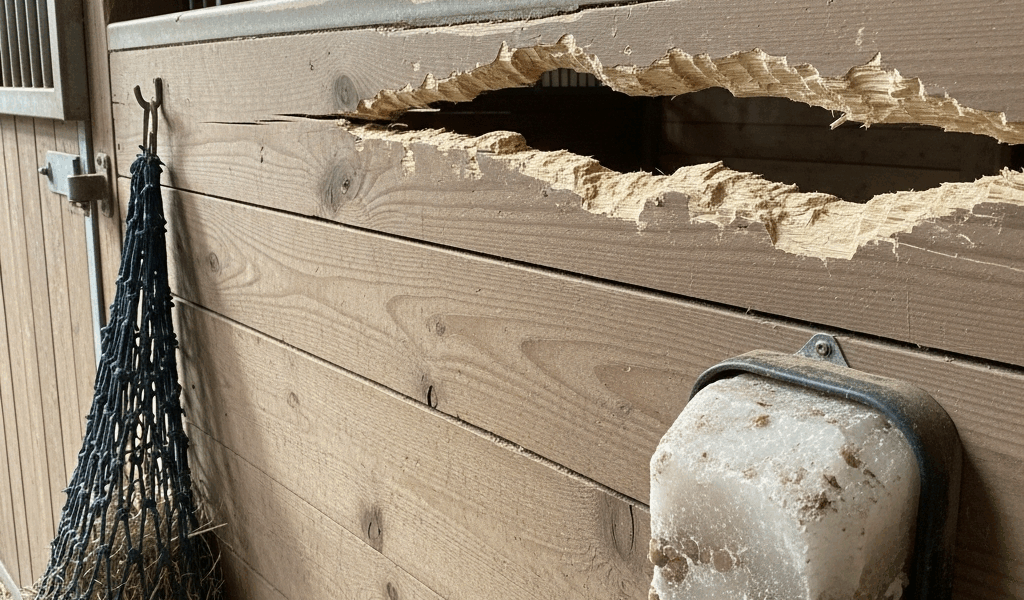
Why Horses Crib and Why It’s So Hard to Stop
Cribbing has gotten complicated with all the misinformation flying around. Owners blame the horse. Trainers sell collars. And nobody stops to ask what’s actually happening inside that animal’s brain. So let me back up and explain it plainly.
A horse cribs because it feels good — chemically good. When the horse grabs a fence rail with its teeth and flexes its neck to pull air in, endorphins release. Real ones. The same kind that make humans feel better after a run. That reward signal gets baked into the nervous system over time, and eventually the brain starts treating cribbing less like a choice and more like a need. It becomes a habit loop the horse’s body actively defends.
That’s what makes cribbing so endearing to us horse people — just kidding. It’s maddening. But understanding the chemistry matters, because it explains why scolding does absolutely nothing. Your horse isn’t being defiant. It found something that works for it, neurologically speaking, and now it can’t easily stop.
Gut pain is usually somewhere in the picture. Ulcers, hind-gut acidosis, chronic digestive inflammation — shockingly common in stabled horses, and most owners never connect the cribbing to what’s happening two feet behind the ribcage. A horse in pain cribs harder. More often. It’s basically self-medication, and it actually works, at least temporarily. That’s the cruel part.
The Fixes That Don’t Actually Work
I’ve watched owners drop $200 on anti-cribbing collars. The device wraps around the horse’s throat and makes it physically painful or mechanically impossible to arch the neck the right way. Horse stops cribbing. Everyone celebrates. Collar comes off two weeks later — and the cribbing comes back, often worse than before.
That rebound effect isn’t a coincidence. The collar never asked why the horse wanted to crib. It just blocked the exit. The frustration of being denied a behavior the brain is actively craving tends to pile onto whatever stress was already there. Experienced trainers see this constantly. I’ve seen it myself.
Same story with electric wire on fence posts, bitter sprays on wood surfaces, and welded metal caps over cribbing spots. These are suppression tools. They move the symptom. They do not touch the cause. Worse, there’s a real risk the horse finds a different outlet — weaving, wind-sucking, fence-pacing. You’ve traded one problem for another and congratulated yourself in between.
There’s also something the horse communicates that owners often miss: if the environment stays the same, the horse knows it. Remove the wooden gate but leave the stall empty by noon, the hay gone by 2 p.m., and no other horse in sight — nothing has changed from your horse’s perspective. It will find something else. Don’t make my mistake of assuming the cribbing spot was the problem.
Step One — Find the Root Cause First
Probably should have opened with this section, honestly. Before you buy anything or call anyone, sit down with a piece of paper and do a real audit. Ask yourself:
- Does your horse have hay or pasture access fewer than 12 hours a day?
- Is your horse stalled more than 16 hours daily?
- Does your horse live alone or without visual contact with other horses?
- Has something changed recently — new barn, trailering, feed switch, new routine?
- Are there other signs: weight loss, dull coat, girthiness, reluctance to eat?
Most people skip straight to collars. The question of why the cribbing started gets skipped entirely. You need that answer first — nothing else works without it.
Limited forage is the single most common trigger I’ve come across. Horses are built to eat nearly constantly — slow, steady trickles of forage across 18 or 20 hours a day. When a horse finishes three flakes at 6 a.m. and the stall sits empty until 5 p.m., that’s 11 hours of nothing. Cribbing fills time. It stimulates the mouth. It does something, which is more than the stall is doing.
Confinement compounds everything. A horse with 12 hours of turnout and free-choice hay almost never develops cribbing, even under stress. A horse with 4 hours of turnout and scheduled feeding twice daily? Much higher risk. The stall becomes a sensory-deprivation box, and the horse’s brain starts looking for any input it can manufacture on its own.
Social isolation matters more than most owners expect. Horses are herd animals — genuinely, not metaphorically. A horse alone in a barn carries low-grade anxiety as a baseline. Even if the feed is perfect and the stall is clean, the psychological pressure builds. Cribbing can start from that alone.
And gut pain creates a physical itch no environment can fully scratch. If ulcers are present, cribbing delivers temporary relief through endorphin release and possibly through the physical motion itself. Treat the ulcers and the cribbing often drops dramatically. Sometimes to near-zero. That’s not a coincidence — that’s causation.
Step Two — Fix the Environment and Routine
Start with forage. This is non-negotiable — at least if you want to make any real progress. Your horse needs hay available at least 16 hours a day. Closer to 20 is better.
If you’re currently feeding twice daily, switch to hay nets. A 1.5-inch hole net — brands like Kencove or Dura-Net run $25–$45 — makes a single flake last 3 to 4 hours instead of 20 minutes. Hang two or three around the stall. Same feed bill, radically different psychological experience for the horse. It’s occupied. Its gut gets steady fuel. The void shrinks.
Slow feeders work on the same principle. A Nibble Net or Porta-Grazer (around $30–$65) forces the horse to pull hay through small openings, mimicking the motion and pacing of actual grazing. Combine that with turnout and you’re addressing two triggers simultaneously.
Speaking of turnout — if your horse currently gets 4 to 6 hours, push toward 8 to 10. No turnout at all? That’s your first fix, before anything else. Even a small dry lot beats a stall. And solitary turnout is mediocre at best. The horse needs movement and company. A companion goat runs $50–$150 to acquire and costs almost nothing to maintain. I’m apparently a goat person now, and honestly, it’s worked better for stall anxiety than anything else I’ve tried.
Stall enrichment costs almost nothing. A Jolly Ball or treat-dispensing toy runs $10–$20. Lick blocks. Hay scattered on the floor instead of racked up in one corner. These aren’t solutions on their own — but they chip away at the sensory void that drives the behavior.
Windows matter too. A horse staring at a blank wall for 18 hours develops problems. A horse that can see other animals, weather changing, people moving around — that horse’s brain has something to work with. It sounds trivial. It isn’t.
When to Call the Vet and What to Ask
Weight loss, dull coat, girthiness, reluctance to eat, behavioral changes beyond cribbing — any of those, schedule a vet visit with ulcer screening specifically on the agenda.
Ask about scoping. Gastric endoscopy runs $200–$400 depending on your vet and region. It’s the only way to actually confirm ulcers rather than guess. Some vets skip it and treat presumptively, which works sometimes — but you lose the diagnostic clarity. If ulcers come back confirmed, treatment is usually omeprazole, sold as GastroGard, for 28 days. Cost runs roughly $300–$600 depending on your horse’s weight and where you source it. It works. I’ve personally watched cribbing drop 70% or more once a horse’s stomach healed.
Ask about hind-gut issues separately. The stomach scope doesn’t show the cecum or right dorsal colon. If ulcers are ruled out and the horse still cribs hard, a 30-day trial of something like EquiShure or Succeed — both target hind-gut pH — is worth exploring. Results vary. But if the front end is clear and the behavior persists, the back end of the gut is the next reasonable question.
Be realistic about where this goes. Environmental fixes and gut treatment help most horses substantially. Some stop cribbing entirely — that happens. Others settle into occasional bouts under high stress. A few continue despite your best efforts because the behavior has been wired in for years and the nervous system has reorganized around it. That’s not failure. That’s just how deeply ingrained stereotypies work. A horse cribbing once a week instead of 40 times an hour is a genuine win. Take it.
This new understanding of cribbing as a neurological and physical issue — rather than a discipline problem — took off among equine researchers several years ago and has slowly evolved into the approach that informed owners and good vets use today. Patience matters more here than any collar or spray ever will. Your horse didn’t develop this overnight, and it won’t unlearn it overnight either.

Leave a Reply