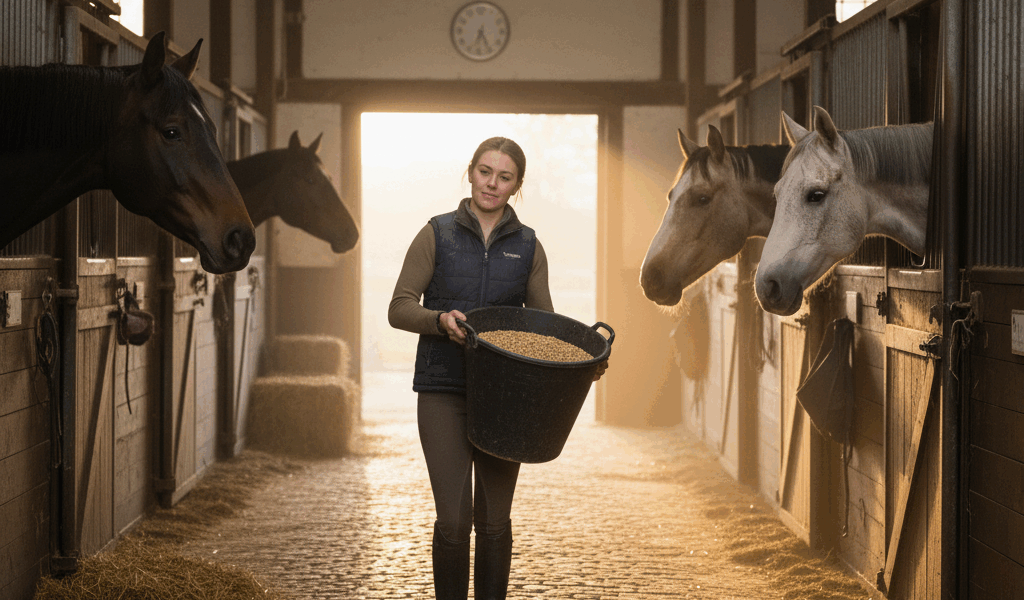
A horse does not need breakfast at exactly 5:00 a.m. The important parts of a feeding schedule are adequate forage, access to fresh water, consistent management, appropriately sized concentrate meals, and a plan matched to the individual horse’s health and workload. An early barn feeding may fit a person’s workday, but the clock time itself is not a nutritional requirement.
This guide covers general feeding management for healthy adult horses. Horses with colic history, ulcers, insulin dysregulation, laminitis risk, dental disease, pregnancy, heavy work, medication needs or weight problems require an individualized plan from a veterinarian and, when appropriate, a qualified equine nutritionist.
Why exact breakfast time matters less than forage access
Horses evolved to consume small amounts of fibrous forage repeatedly. The Merck Veterinary Manual explains that most healthy horses should have free access to suitable hay or pasture, salt and fresh water, and that many horses on good-quality forage need little or no concentrate.
If a horse has safe, appropriate forage available overnight, moving a small concentrate meal from 5:00 to 6:00 a.m. is different from leaving the horse without forage for a long interval and then delivering a large meal. Evaluate the entire 24-hour feeding pattern rather than focusing only on “breakfast.”
Build the schedule around forage
Forage should form the foundation of the ration. The amount and type depend on body weight, body condition, pasture, hay analysis, workload and health. Our daily horse-diet guide explains the main ration components.
For horses without continuous pasture or hay access, management options may include:
- More frequent hay deliveries
- Appropriately designed slow feeders
- Several feeding locations to reduce competition
- Turnout timed around safe pasture conditions
- Individual feeding when herd hierarchy prevents adequate intake
Slow feeding is not suitable in every setup. Nets, racks and feeders must be installed to reduce entanglement, dental and injury risks, and the horse still needs enough total forage.
Concentrate meals should be measured and divided
Grain and commercial concentrates are not automatically necessary. When a veterinarian or nutrition plan calls for them, weigh the feed rather than relying on scoop volume because products have different densities.
Merck advises against feeding more than 0.5% of body weight in grain-based concentrate at one meal and recommends dividing larger daily amounts into multiple smaller meals. Some horses require a substantially lower meal size because of medical or metabolic concerns. Follow the product label and individualized professional advice.
Do not compress several missed meals into one oversized feeding. If a schedule failure occurs, restore the plan cautiously rather than “making up” the full amount at once.
Consistency does not mean minute-by-minute rigidity
A regular routine helps staff coordinate care and makes appetite changes easier to detect. It also reduces abrupt ration changes. But feeding at 5:07 one morning and 5:40 the next is not inherently a crisis when forage and water remain available and the horse is otherwise managed appropriately.
The schedule should be dependable enough that:
- No horse is accidentally skipped
- Concentrate meals stay appropriately separated
- Medication timing follows veterinary instructions
- Work and transport are coordinated with meal size
- Staff can identify reduced appetite promptly
- Forage gaps are minimized
A practical daily framework
There is no universal schedule, but a barn might organize care around morning, midday, evening and overnight checks. The exact times depend on turnout, labor, climate and individual plans.
Morning
- Confirm each horse is alert and behaving normally
- Check water availability and obvious manure output
- Assess remaining forage to detect unusual intake
- Provide prescribed feed and medication accurately
- Inspect the stall or turnout area for hazards
Midday
- Recheck water and forage
- Confirm vulnerable horses are actually eating
- Adjust turnout or shelter management for weather
- Provide an additional small meal when the ration requires it
Evening and overnight
- Reassess appetite, hydration and behavior
- Provide the planned forage for the overnight interval
- Confirm medications and supplements against the record
- Check gates, feeders and water systems
This is an observation framework, not a ration. Feed amounts must be based on the horse and forage quality, not copied from another barn.
Coordinate feeding with exercise
Large concentrate meals should not be placed immediately before strenuous exercise, transport or another major stressor. Merck notes concerns with large grain-based meals close to intense work and recommends appropriate spacing. Forage management around exercise is different from concentrate management and depends on the discipline and horse.
If early riding is the reason for a 5 a.m. feeding, ask a veterinarian or equine nutritionist how the specific ration should be timed. Do not use a general internet timetable for a racehorse, endurance horse or horse with gastric disease.
Make feed changes gradually
A new hay lot, concentrate, supplement or pasture exposure can change the ration even when meal times stay the same. Avoid abrupt changes. Introduce alterations gradually under professional guidance, monitor manure, appetite and behavior, and keep product labels and lot information.
Hay can vary substantially in nutrients. Our hay-quality guide explains visual inspection and why laboratory analysis is more useful than color alone.
Season and weather change the management plan
Cold, heat, pasture growth, travel and workload can affect water intake, forage use and energy needs. The response should be a reviewed ration and management plan, not random extra grain. Use our seasonal horse-feeding guide to identify conditions that deserve reassessment.
Check water more often during freezing or hot conditions and verify that automatic systems function. A full-looking bucket or trough is not proof that clean water is accessible and being consumed.
Group feeding requires individual observation
Horses in a group do not necessarily receive an equal share. A dominant horse may control a feeder while a timid, elderly or newly introduced horse eats less. Provide sufficient space and feeding points, observe actual access, and separate horses when individual concentrate or medication must be consumed accurately.
Body-condition scoring and weight estimates should be recorded over time. A horse can appear to participate in every feeding while gradually losing condition.
When an appetite change is urgent
A horse that unexpectedly refuses feed, has reduced manure, repeatedly looks at the flank, paws, rolls, sweats, appears depressed, has abdominal distension or otherwise seems abnormal may need urgent veterinary assessment. Do not wait for the next scheduled meal to see whether obvious colic signs resolve.
Remove access to additional concentrate and contact a veterinarian for instructions. Do not administer medication or force feed unless directed.
Feeding records prevent mistakes
Use a chart or digital record that lists each horse, feed by weight, forage plan, medication, supplements, allergies or restrictions, and responsible person. Initial each completed feeding. Update the master instructions when the veterinarian or nutrition plan changes rather than relying on a note taped over an old label.
Label bins clearly and store feed to prevent moisture, pests and accidental access. Remove spoiled, moldy or contaminated feed.
Horse feeding schedule checklist
- Provide continual or frequent access to appropriate forage when medically suitable
- Maintain fresh water and salt access
- Weigh concentrates instead of relying on scoop volume
- Divide necessary concentrate into appropriately sized meals
- Avoid abrupt feed, hay and pasture changes
- Coordinate large meals with exercise and transport
- Observe individual intake in group settings
- Record feed, supplements and medication accurately
- Monitor body condition, appetite, manure and behavior
- Contact a veterinarian promptly for sudden appetite loss or colic signs
Bottom line
Feeding at 5 a.m. can be a practical barn routine, but it is not inherently healthier than another consistent time. Design the day around forage access, water, appropriate meal size, individual needs and reliable observation. The best schedule is the one that supports the horse’s full 24-hour ration and can be followed safely every day.

Leave a Reply