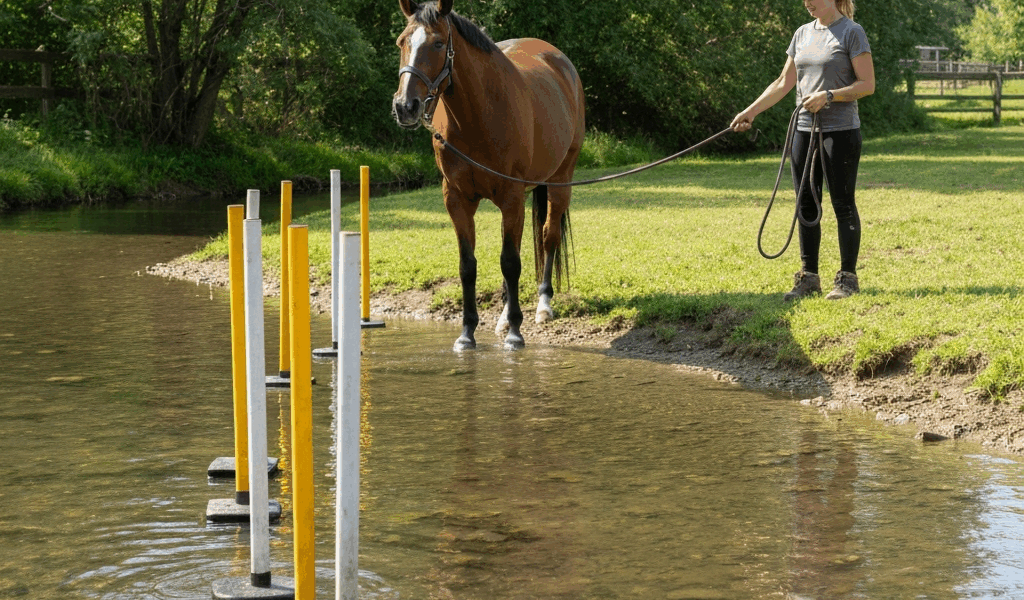
Horse Keeps Refusing to Cross Water — What Works
I spent three years avoiding water crossings on my Quarter Horse mare because I thought she was just stubborn. Turns out, she was terrified. Once I understood what was actually happening in her brain — and stopped trying to force her through — we crossed a creek without incident within six weeks. The difference wasn’t magical or complicated. It was patient, systematic desensitization paired with understanding why horses resist water in the first place.
If your horse keeps refusing to cross water, you’re not alone. This is one of the most common obstacles trail riders and event competitors face. The frustration builds fast when you’re stuck on one side of a creek while your riding buddy trots across without a care. But here’s what I learned: punishment, force, and “just pushing through” almost always makes it worse.
Why Horses Refuse Water in the First Place
Horses aren’t being difficult when they plant their feet at a water crossing. Their eyes are literally wired differently than ours.
Equine vision has a significant blind spot directly in front of their face. When a horse approaches water, they can’t actually see the bottom — no matter how clear it is. From their perspective, they’re looking at a dark void. Add in the reflection of the sky, and it looks even more like nothingness. That’s not stubbornness. That’s a horse trying not to walk into what appears to be a bottomless pit.
Then there’s the physics of it. Horses have hooves, not feet with flexible joints. When a hoof lands on wet, slippery ground, it slides differently than on dry dirt. The horse can’t predict that sensation in advance, which triggers a self-preservation instinct. They’ve learned that water equals unpredictable footing.
Many horses also can’t hear themselves walking through water the same way they hear footsteps on land. The muffled, hollow sounds are unfamiliar. Unfamiliar equals threatening in a prey animal’s mind.
Finally, one bad experience compounds everything. I watched a friend’s horse slip crossing a creek once — just once — and that horse refused water for two years afterward. One negative experience hardwired into her memory: water equals falling, water equals danger. Learned behavior is incredibly sticky with horses.
Pre-Water Training on Dry Land
Before your horse sees a single puddle, you need groundwork. Real groundwork, not just lunging in circles.
Start with desensitization to water sounds. Run a hose near your horse while you’re grooming or leading them. Let them hear splashing without the pressure of crossing anything. Most horses relax around this within 2–3 days of short 5-minute sessions. You’re proving that water noise doesn’t hurt them.
Move to tactile experiences. Lay a blue tarp flat on the ground in an arena or round pen. A 6-foot by 8-foot tarp works well — mine’s a Frost King from the feed store. Lead your horse over it. Don’t lunge or force — just calmly ask them to walk across. Most horses will hesitate. That’s normal. Let them sniff it first. Touch it with one hoof. Back up if they panic. Try again in 30 seconds.
Here’s what to watch: pricked ears mean curiosity. Flared nostrils and wide eyes signal fear. A horse that’s backing away but not bolting is thinking — that’s progress. A horse that’s rearing or spinning is too scared. Step back and make the task easier. Walk alongside the tarp instead of over it. Let them investigate at their own pace.
Once the tarp is routine, add ground poles. Place three poles on the ground about 3 feet apart. Lead your horse over them. This teaches their brain that obstacles require attention and careful placement of hooves. It builds the neural pathway for picking through uncertain terrain — exactly what they’ll need at water.
Probably should have opened with this section, honestly, because it’s where most people skip steps. They want to skip straight to the water. Don’t make my mistake. The groundwork is where the actual learning happens.
Progress to walking over shallow obstacles — a shallow box filled with water (12 inches deep, 4 feet long), or a creek bed that’s dry in summer. Your horse is learning that stepping through things that look vague or different is survivable.
The Gradual Water Approach Method
Once your horse walks over blue tarps and poles confidently, it’s time to find water. Start small. A puddle. A ditch with a trickle. Something contained.
Session one is walk-by. Position yourself and your horse alongside the water, parallel to it. Don’t approach head-on. Walk past it. The goal is zero pressure. You’re just existing near water. One calm pass is success. Repeat 2–3 times if the horse is relaxed. End on a win and leave.
Session two (ideally 3–5 days later) is wade at the edge. Dismount. Leading your horse from the ground, walk to the water’s edge. Don’t enter. Let your horse lower their head and investigate. Smelling it is crucial — their senses tell them it’s just water, not a trap. Stand there for 1–2 minutes if they’re calm. Then back away slowly. Praise heavily.
Session three, ask for one hoof in. Same position — you leading from the ground. Ask your horse to step forward gently. If one front hoof lands in the water, stop. Let them stand there. This is monumental progress. Your horse is overriding the instinct that says “don’t.” Back up after 30 seconds. End session. Celebrate.
Session four, belly-deep. This might take two or three separate attempts. Your horse needs to walk deeper into the water. The key here: never pull. Coax. Use a cluck or kiss sound. Let gravity do some work — position yourself and your horse so they naturally want to move forward. Some horses need a buddy horse to go first. That’s fine. Use whatever tool works.
Session five is full crossing — riding across if you started mounted, or leading completely across if you started on foot.
The timing matters. Don’t rush to session three if your horse is still panicking during session two. Some horses need two weeks between steps. Others need two sessions per stage. You’re reading your horse’s actual responses, not a calendar.
What do you do if your horse panics mid-crossing? Don’t escalate. Don’t smack or kick. Sit deep, breathe deliberately, and simply hold pressure on the rein to keep their head up. Often horses panic and want to rear or spin. A lifted head prevents rearing. Let them stand and collect themselves. Then ask for one step forward. One step. Then another. Slow the entire process down.
Common Mistakes That Make It Worse
Forcing the crossing is the most obvious mistake — and the most common. Beating a horse through water teaches them that water equals pain, not water equals safe. They’ll refuse harder next time.
Punishing refusal is the same mistake with a different tool. Every time your horse refuses and you get angry, the association deepens: water is bad, refusing water gets you yelled at, so water must be legitimately dangerous.
Dismounting and dragging your horse through water is actually traumatic. You’re physically overpowering them, removing their choice, and creating a panicked situation. Most horses that have been dragged become worse at water crossing, not better.
Using too much leg pressure confuses the signal. Your horse doesn’t understand “kick means go through water.” They understand “pressure means move,” which creates tension. Soft, consistent pressure paired with patience works better than strong pressure paired with frustration.
Flooding — putting your horse in deep water immediately — is the opposite of desensitization. It’s traumatization. Some trainers still recommend “just take them through the deep end.” This creates the exact learned behavior you’re trying to undo.
When to Call a Professional Trainer
Your horse is showing extreme panic — rearing repeatedly, bolting sideways, or trying to flip backward — and nothing you’re doing is reducing that panic over 2–3 sessions.
Your horse has documented past trauma from water. Maybe they were caught in a flood as a weanling, or nearly drowned as a younger horse. That’s neurological fear, not learned refusal. It requires specialized handling.
You feel unsafe. If your horse’s panic is creating a situation where you can’t control them, that’s a signal to bring in someone with more experience.
A professional trainer who specializes in desensitization — not dominance-based training — can often accelerate progress. They have access to multiple water scenarios, buddy horses, and a body of experience with resistant cases.
But for most horses with learned water refusal, your own patient approach works. It just takes time. My mare went from a complete stop at the creek to wading belly-deep within four weeks. At week six, we crossed at a trot. It wasn’t magic. It was patience and understanding how her brain actually works.


Leave a Reply